
Introduction: The Cartesian Dualism of the Ticker
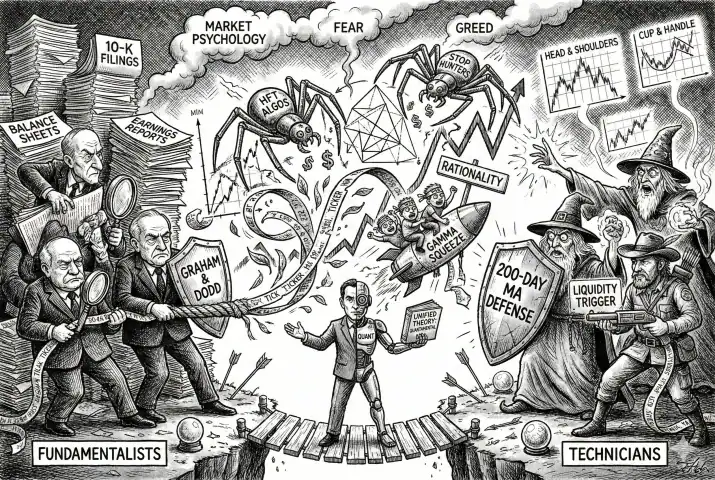
In the high-stakes theater of modern finance, there exists a schism as old as the ticker tape itself. On one side are the fundamentalists—the Graham-and-Dodd disciples who view a stock certificate as a claim on future cash flows, a tangible slice of a corporate entity to be weighed, measured, and valued against the bedrock of its balance sheet. To these sober analysts, the price of a stock is a slave to its earnings; if the price deviates, it is merely a temporary error of the market’s mood, a Mr. Market depressive episode or manic high that will eventually correct itself to the mean.
On the other side are the technicians, the chartists, the readers of the tape. To the fundamentalist, the technician is little more than a palm reader or an astrologer, drawing lines on a screen to predict the future based on the geometric shapes of the past. The technician, however, retorts that the fundamentalist is an historian, analyzing data that is already obsolete by the time it hits the SEC filing system. To the technician, the price is not a mistake; the price is the only truth. It is the aggregate psychological consensus of every participant in the market, from the high-frequency algorithm sniffing out liquidity to the pension fund manager rebalancing a multi-billion dollar portfolio, to the retail trader betting their stimulus check on a meme.
The reality, as is often the case in binary debates, lies in a messy, lucrative middle ground. The most successful market participants in history—from the macro-trading wizards of the 1980s to the algorithmic black boxes of the 2020s—have rarely adhered to a strict monotheism of style. They are quantamentals, investors who use fundamentals to determine what to buy, and technicals to determine when to buy it. They understand that while earnings may drive the destination, human psychology (and increasingly, machine logic) drives the path.
This article bridges that divide. It is not a defense of voodoo finance, nor is it a dry recitation of accounting principles. It is an examination of how price action—the raw data of the market—can be decoded. We explore the methodologies of hedge fund titans who use charts as risk management tools, the statistical reliability of geometric patterns, the interplay between earnings events and implied volatility, and the new market structure defined by gamma squeezes and algorithmic stop-hunting. We look at the market not just as a series of numbers, but as a graph of human fear, greed, and the increasingly complex plumbing of market microstructure.
The Philosophy of Price
To understand chart analysis, one must first accept a core premise: the market is a discounting mechanism. It looks forward, not backward. By the time a company reports record earnings, the smart money—the institutional giants and well-connected hedge funds—has likely already positioned itself. The chart, therefore, is a footprint of this positioning. It reveals accumulation (buying) and distribution (selling) before the news becomes public.
As Matt Levine, the Bloomberg columnist known for his sharp wit and deep understanding of market plumbing, might observe: The stock market is a mechanism for transferring money from people who think they know what is happening to people who actually know what is happening, with a small fee extracted by people who build the computers that facilitate the transfer. Chart analysis, in its purest form, is the attempt to spot the tracks of those people who actually know before they have finished their business.
Part I: The Titans of Tape – Case Studies in Institutional Charting
The most compelling argument against the dismissal of technical analysis is the bank accounts of those who use it. While academia has historically scoffed at the predictive power of past prices, the practitioners of the dark art have quietly amassed fortunes. However, unlike the caricature of the day trader staring at 15-minute candles, these titans use technicals as part of a broader, robust framework.
Paul Tudor Jones – The 200-Day Defense
Paul Tudor Jones (PTJ), the founder of Tudor Investment Corporation, is perhaps the most famous macro trader in history, largely due to his prescient prediction of the 1987 stock market crash (Black Monday). While Jones is a macro trader—analyzing interest rates, deficits, and economic health—his execution is deeply rooted in technicals.
In the lead-up to 1987, Jones noted that the market trajectory bore a haunting resemblance to the price action preceding the 1929 crash. This was not merely a visual match; it was a rhythmic rhyme of speculation and overextension. However, Jones did not simply short the market because the lines looked similar. He combined this technical observation with a fundamental thesis: the market was overvalued, and liquidity was drying up.
His secret weapon, however, is surprisingly simple: the 200-day moving average. Jones has famously stated that his metric for everything is the 200-day moving average of closing prices. He has seen too many things go to zero to ignore it. The trick in investing is how to keep from losing everything. If you use the 200-day moving average rule, you get out. You play defense.
The 200-day moving average (MA) acts as a binary filter for Jones. It is not an indicator that tells him to buy at the bottom; it is a filter that tells him when the regime has changed. If the price is above the 200-day MA, the trend is bullish, and the market is innocent until proven guilty. If the price is below the 200-day MA, the trend is bearish, and the market is guilty until proven innocent. This is not an entry strategy designed to catch the exact bottom; it is a survival strategy designed to avoid the long, agonizing slide of a secular bear market.
Beyond the 200-day MA, Jones employs a strict risk management framework derived from chart patterns. He seeks setups with a 5-to-1 risk-reward ratio. This means he is risking 1 dollar to make 5. He admits that this ratio allows him to have a hit ratio of only 20%. He can be wrong 80% of the time and still not lose money. This mathematical approach necessitates technical analysis. Fundamental analysis gives you a price target (the reward), but only technical analysis can give you a precise stop-loss level (the risk).
Stanley Druckenmiller – Technicals as the Trigger
If Paul Tudor Jones uses charts for defense, Stanley Druckenmiller uses them for timing. Druckenmiller, who managed money for George Soros and later ran Duquesne Capital, is celebrated for his 30-year track record without a single down year. His philosophy is aggressive, concentrated, and heavily reliant on technical confirmation.
Druckenmiller is best known for breaking the Bank of England in 1992, a trade where he bet heavily against the British Pound (Sterling). The fundamental thesis was clear: the UK economy was in recession, but the Bank of England was artificially propping up the currency to stay within the European Exchange Rate Mechanism (ERM). They needed to lower interest rates to stimulate the economy, but high rates were required to defend the currency. It was an unsustainable paradox.
However, knowing a currency should fall and knowing when it will fall are two different things. Druckenmiller waited. He watched the price action. He looked for a technical breakdown that confirmed the market had stopped believing the Bank of England’s rhetoric. When the chart broke key support levels, confirming that selling pressure was overwhelming the central bank’s buying power, he struck. When he pitched the idea to Soros, suggesting a 100% allocation, Soros famously retorted that it was the most ridiculous use of money management he had ever heard because if the trade was that good, they should be 200% levered. Soros taught him that it takes courage to be a pig.
Druckenmiller famously stated that he never uses valuation to time the market, but rather uses liquidity considerations and technical analysis. Valuation only tells him how far the market can go once a catalyst enters the picture. He views the technicals as a thermometer for the market health. If the fundamentals suggest a company is a screaming buy, but the price is making lower lows and underperforming the sector, Druckenmiller will wait. He trusts the wisdom of the crowd embedded in the price action more than his own spreadsheet models.
William O’Neil & Mark Minervini – The Architecture of Momentum
Moving from billionaires to the champions of the individual trader style, William O’Neil (founder of Investor’s Business Daily) and Mark Minervini represent the pinnacle of the momentum or trend following school. Their methodologies are highly specific, visual, and rigorous, focusing on identifying the super-performance phase of a stock life cycle.
William O’Neil’s CAN SLIM system is the gold standard for the Quantamental approach. It uses fundamental metrics to select which stocks to buy, and chart patterns to select when to buy them. The N in CAN SLIM stands for New Highs. While most retail investors are scared to buy stocks at all-time highs because they seem expensive, O’Neil found that the biggest winners tend to make new highs and then go much higher. The chart validates the fundamentals. Buying cheap stocks often means buying damaged goods.
Mark Minervini, a U.S. Investing Champion, refined O’Neil’s concepts into the Volatility Contraction Pattern (VCP). The VCP is based on the physics of supply and demand. Minervini looks for a stock that is in a long-term uptrend but has entered a consolidation period. During this consolidation, he wants to see the volatility contract—the price swings get tighter and tighter, moving from left to right on the chart. This tightening action indicates that the weak hands (impatient holders) have been washed out. When the price finally breaks above the pivot point, even a small amount of demand can send the stock soaring because there is no supply left to check the advance.
Jim Simons & Renaissance Technologies – The Quantitative Anomaly
At the far end of the spectrum lies Jim Simons, a mathematician whose firm, Renaissance Technologies, effectively solved the market. Unlike Jones or Druckenmiller, who use intuition and discretion, Simons’ Medallion Fund uses automated pattern recognition on a massive scale.
Simons’ team does not look for Head and Shoulders patterns in the traditional, visual sense. Instead, they look for statistical anomalies—ghostly echoes in the data where price Y follows price X with a probability slightly higher than 50%. Recent studies in 2024 and 2025 have begun to validate this approach using modern machine learning. Researchers have found that Long Short-Term Memory (LSTM) networks—a type of AI—can significantly outperform traditional technical indicators like the Exponential Moving Average (EMA) or MACD in predicting price movements. This suggests that the patterns exist, but they are becoming too complex for the human eye to see, requiring neural networks to decode.
Part II: The Taxonomy of Lines – Mechanics, Patterns, and Reliability
Having established that the greats use charts, we must now define how they use them. Not all patterns are created equal. The internet is awash with memes mocking technical analysis, but statistical analysis provides a way to separate the signal from the noise.
Academic research utilizing kernel regression to smooth price data has successfully detected patterns like Head and Shoulders and Double Bottoms automatically. The conclusion of these studies is groundbreaking: certain technical patterns do provide incremental information and add value to trading strategies, contradicting the strongest forms of the Efficient Market Hypothesis (EMH). However, the reliability of these patterns is heavily context-dependent.
Statistical Reliability
Data from Thomas Bulkowski, widely considered the leading statistician of chart patterns, along with more recent AI-driven backtests, provides a realistic view of success rates in bull markets.
The Head and Shoulders is a bearish reversal pattern that is historically reliable (89-93% success rate when accompanied by volume). It consists of three peaks: a higher high (Head) flanked by two lower highs (Shoulders). The breakdown occurs when the price breaches the neckline support.
The Cup and Handle is a bullish continuation pattern. It resembles a tea cup viewed from the side. The cup represents a healthy correction where institutional investors accumulate shares, while the handle is a final shakeout of nervous holders. Success rates for this pattern are high (around 85% for long-term holds), particularly when the cup is rounded rather than sharp.
The Golden Cross (50-day MA crossing above the 200-day MA) and Death Cross (50-day MA crossing below the 200-day MA) are the most cited signals in mainstream media. While a Death Cross often precedes major bear markets, it also generates many false signals in sideways markets. Professional funds rarely trade solely on a crossover; they use it as a regime filter to adjust their gross exposure rather than a tactical trigger.
Part III: Contextual Warfare – The Fundamental Fusion
Charts do not exist in a vacuum. A Cup and Handle on a company about to go bankrupt is not a buying opportunity; it is a tombstone. The most robust analysis combines technicals with fundamentals—the Quantamental approach.
Trading Around Future Events – The Earnings Game
One of the most dangerous times to rely on pure chart patterns is immediately before a known binary event, such as an earnings release. Before earnings, uncertainty is high, so Implied Volatility (IV) spikes, making options expensive. This is the market pricing in the gamble. If a trader buys call options based on a bullish pattern just before earnings, they risk the IV Crush. Even if the stock rallies, the collapse in volatility after the news is released can suck the value out of the option premiums faster than the stock price increase adds to them.
Studies show that stock prices often drift in the direction of the earnings surprise after the announcement, a phenomenon known as Post-Earnings Announcement Drift (PEAD). Professional traders often wait for the release. If the news is good and the stock gaps up, they look for a technical consolidation (like a flag) after the gap to enter. This avoids the binary risk of the event while capturing the institutional accumulation that follows a beat. The rule of thumb is simple: Gamblers hold through earnings; professionals trade the reaction.
The Macro Overlay – Don’t Fight the Fed
Just as earnings disrupt individual charts, Federal Reserve announcements disrupt the entire market. Research indicates a Pre-FOMC Drift, where equities tend to appreciate in the 24 hours leading up to a scheduled announcement, followed by a resolution of uncertainty. Charts often tighten into a wait and see range prior to the Fed. Breakouts from these patterns before the announcement have a high failure rate because liquidity is thin. The true move happens only after the policy decision is digested.
Part IV: The Modern Battlefield – Algos, Memes, and Mechanics
The market of the 1980s is gone. Today, 70-80% of volume is driven by machines, and a significant minority is driven by coordinated retail crowds on social media. This has altered the physics of the chart.
HFT and Stop Hunting – The Algorithms That Eat Charts
High-Frequency Trading (HFT) algorithms do not care about the P/E ratio. They care about order flow and liquidity. Retail traders are often taught to place stop-loss orders just below obvious support levels. This creates a liquidity pool. HFT algorithms can estimate where these clusters of stop orders are. If the price gets close, the algo may push the price down just enough to trigger these stops. When retail stops are triggered, they become market sell orders. The HFT buys into this selling avalanche at a discount, and the price immediately reverses back up. On a chart, this looks like a long thin tail or wick extending below support. To a pro, this is a Spring or Bear Trap—a strong bullish signal indicating that liquidity has been harvested.
The Gamma Squeeze – Weaponized Options and Memes
The saga of AMC and GameStop introduced the world to the Gamma Squeeze, a phenomenon where options activity forces technical moves independent of fundamentals. When retail traders buy cheap, Out-of-the-Money call options en masse, Market Makers who sold those calls must hedge their risk. To stay hedged, they must buy the underlying stock. As the stock rises, they must buy even more. This feedback loop drives the chart vertical, dissociating price from resistance levels.
You can often see these dynamics play out in real-time discussions that blend humor with high-stakes gambling:
See: Gamma Squeeze Explained on r/WallStreetBets (Reference 1)
When a squeeze is in play, discussion volume acts as a sentiment thermometer. A divergence where price rises but social volume falls can indicate a trend is losing its viral energy.
Part V: Skepticism, Theory, and Conclusion
The Efficient Market Hypothesis (EMH) argues that all information is instantly priced in, making it impossible to beat the market using charts. However, Behavioral Finance counter-argues that while information may be efficient, the reaction to information is not. Humans overreact to fear and underreact to subtle changes. This creates trends and momentum. Charting is simply the visualization of this momentum.
Critics also argue that technical analysis is a self-fulfilling prophecy. If enough traders put buy orders at the 200-day Moving Average because Paul Tudor Jones said so, the price will bounce off the 200-day MA. For the trader, it does not matter why it works—magic, psychology, or prophecy. It only matters that it works. The chart is a shared language; if everyone speaks it, one must learn it to communicate.
The Unified Theory
The Holy Grail of analysis is not a single indicator, but a confluence of factors. The ideal trade—the Fat Pitch—looks like a perfect alignment: Macro tailwinds are blowing (Fed is dovish), fundamental growth is accelerating (earnings are up), a technical trigger has occurred (stock breaking out of a consolidation), and sentiment is interested but not euphoric.
Paul Tudor Jones didn’t use the 200-day MA because he loved geometry; he used it because he hated losing money. The chart is a map of human emotion. It is messy, it is prone to fake-outs, and it is often irrational. But it is also the most honest document on Wall Street. The 10-K filing can be massaged by accountants; the press release can be spun by PR firms. But the price—the point where a buyer and a seller agreed to exchange cash for equity—cannot lie. It is the only reality that matters.
Reference Section
1. Gamma Squeezes and Retail Sentiment
- Context: This video serves as a case study for the AMC Gamma Squeeze. It explains the mechanics of how retail buying pressure forces Market Makers to hedge, creating a feedback loop unrelated to company fundamentals.
2. Paul Tudor Jones and the 1987 Crash
- Context: A documentary clip featuring Paul Tudor Jones explaining his use of the 200-day moving average and risk-reward ratios. Primary source for defensive charting philosophy.
3. Pattern Reliability and Machine Learning
- Link: https://arxiv.org/html/2511.00665v1
- Context: A recent study comparing Machine Learning models (LSTM) against traditional technical indicators. Evidence that modern quant funds are moving toward AI-driven pattern recognition.
4. Mark Minervini’s Volatility Contraction Pattern (VCP)
- Link: https://deepvue.com/screener/how-mark-minervini-screens-for-stocks/
- Context: A detailed breakdown of the VCP setup, useful for understanding the specific geometry of tightening price action before a breakout.
5. Matt Levine’s Money Stuff
- Link: https://newsletterhunt.com/newsletters/money-stuff-by-matt-levine
- Context: Recommended reading for the requested tone of high finance blended with accessible wit.
Leave a Reply