
1. Introduction: Bridging the Great Divide
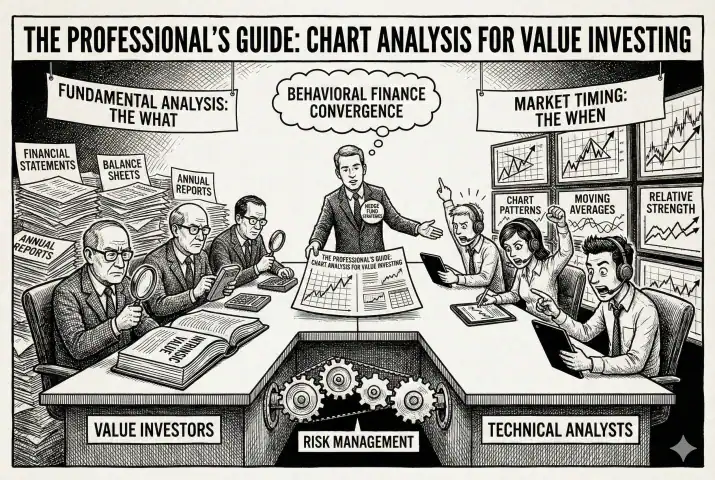
In the annals of financial market theory, a deep and often contentious schism has historically separated two distinct schools of thought: fundamental analysis and technical analysis. The fundamentalist, a disciple of Benjamin Graham and David Dodd, views the market as a voting machine in the short term but a weighing machine in the long term. To this investor, the chart is noise; the truth lies within the balance sheet, the income statement, and the discounted cash flow model. Conversely, the technician, often dismissed by academics as a reader of tea leaves or a practitioner of financial astrology, believes that all known information—fundamental, psychological, and geopolitical—is instantly discounted into price. To the technician, the chart is not noise; it is the only truth that matters because it represents the actual exchange of capital.
However, the evolution of modern finance, driven by the proliferation of hedge funds, high-frequency trading algorithms, and the democratization of data, has largely eroded this binary distinction among elite practitioners. The most successful market participants today operate at the intersection of these disciplines, employing a Techno-Fundamentalist approach. This report serves as a comprehensive guide for the professional columnist seeking to articulate this convergence. It argues that for the value investor, chart analysis is not a substitute for due diligence but a critical tool for risk management and capital efficiency. While fundamentals determine what to buy—identifying the discrepancy between price and intrinsic value—technical analysis dictates when to buy, optimizing the entry point to align with the flow of institutional capital.
Through an exhaustive examination of case studies involving market legends like William O’Neil, Paul Tudor Jones, and Jim Simons, and a rigorous review of academic literature in behavioral finance, this report outlines how chart analysis reveals visual representations of human psychology. It explores how market mechanics, such as the Disposition Effect, create predictable price structures like support and resistance. Furthermore, it provides a detailed taxonomy of how specific corporate and macroeconomic events—ranging from earnings releases to Federal Reserve meetings—manifest in price action, offering the astute value investor a roadmap for navigating future volatility. By synthesizing the rigorous logic of financial statements with the empirical reality of price trends, this document establishes a logical, easy-to-understand framework for the modern investor.
2. Theoretical Foundations: Behavioral Finance and the Validity of Price Action
To write a credible professional column on this subject, one must first dismantle the skepticism that surrounds chart analysis, particularly within the value investing community. This skepticism is not unfounded; it is rooted in the Efficient Market Hypothesis (EMH), which posits that asset prices fully reflect all available information, rendering the search for patterns in past price movements futile. However, the burgeoning field of behavioral finance has provided a robust academic counter-narrative, validating technical analysis not as a crystal ball, but as a method for quantifying irrational investor behavior.
2.1 The Disposition Effect and the Mechanics of Resistance
The most potent concept linking behavioral psychology to chart analysis patterns is the Disposition Effect. Academic research has extensively documented this phenomenon, defined as the tendency of investors to sell assets that have increased in value while holding onto assets that have decreased in value. The psychological driver here is loss aversion—the pain of realizing a loss is psychologically twice as potent as the pleasure of realizing an equivalent gain. Consequently, investors hold losing positions in the hope that prices will return to their break-even point.
This behavioral bias provides the theoretical underpinning for one of the most fundamental concepts in chart analysis: Resistance. Consider a stock that falls from $100 to $80. Investors who purchased at $100 are now holding a paper loss. As the stock rallies back toward $100, these stale holders experience a sense of relief and a desire to exit the trade at cost to eliminate the psychological burden of the loss. Their collective selling pressure creates a ceiling on the stock price at $100, which appears on a chart as a resistance level. Thus, a value investor looking at a chart is not merely seeing a line; they are seeing a visual map of the market’s aggregate regret.
Furthermore, recent academic studies have advanced this understanding by linking technical indicators to informed trading. Research utilizing the Proportion of Contrarian (PC) Trades indicator has demonstrated that informed traders—those with private information or superior analysis—often exploit these behavioral biases. They understand that retail investors will react predictably to technical signals, and they may strategically manipulate these indicators to generate liquidity for their own entries or exits. This implies that chart patterns are not random; they are often the footprints of smart money interacting with the behavioral biases of the herd.
2.2 The Retail vs. Institutional Divide
Understanding the sentiment of market participants is crucial for any analysis. A review of retail investor discussions reveals a stark dichotomy in how technical analysis is perceived compared to its implementation by professionals. A significant faction of retail investors dismisses technical analysis as astrology for men, arguing that it is a pseudoscience lacking empirical basis. This sentiment often stems from a misuse of the tool; retail traders frequently look for certainty and prediction, whereas professional trading is fundamentally about probability and risk management.
In contrast, institutional investors and hedge funds integrate chart analysis as a core component of their decision-making process. They utilize it not to predict the future with certainty, but to frame their risk. For instance, hedge funds often employ technical analysis to time entry and exit points for positions derived from fundamental research. The self-fulfilling prophecy critique—that patterns work only because enough people believe in them—is partially true but misinterpreted. In an era dominated by algorithmic trading, where computers are programmed to recognize and act upon technical levels like the 200-day moving average or the Golden Cross, these patterns become critical liquidity events. For the value investor, ignoring these levels is akin to ignoring the weather report; one may not believe the weatherman controls the rain, but it is prudent to carry an umbrella when a storm is forecast.
2.3 Academic Validation of Momentum and Drift
Beyond the disposition effect, academic literature supports the existence of Momentum and Post-Earnings Announcement Drift (PEAD), both of which challenge the semi-strong form of the Efficient Market Hypothesis. Momentum strategies, which involve buying winners and selling losers, have been shown to generate abnormal returns, suggesting that markets underreact to news in the short term and overreact in the long term. Similarly, PEAD describes the tendency for a stock’s price to continue moving in the direction of an earnings surprise for weeks or months after the announcement. These anomalies provide the empirical justification for the Techno-Fundamentalist approach: if markets were truly efficient, price adjustments would be instantaneous, and charts would be useless. The fact that trends persist confirms that value is recognized gradually, creating a window for the astute analyst to enter.
3. The Masters of the Craft: Case Studies in Chart Analysis
To provide authoritative advice in a professional column, it is essential to move beyond theory and examine the practical application of these concepts by the most successful investors in history. The following case studies demonstrate that the integration of value and chart analysis is not a niche strategy but a hallmark of market mastery.
3.1 William O’Neil: The CAN SLIM Methodology
William O’Neil stands as the progenitor of the modern Techno-Fundamentalist approach. His CAN SLIM strategy is a rigorous system that demands specific fundamental criteria be met before a chart pattern is even considered. O’Neil’s work is particularly relevant for value investors seeking growth at a reasonable price, as it emphasizes that the cheapness of a stock is irrelevant without a catalyst for appreciation.
3.1.1 The Fundamental Engine (C-A-N)
O’Neil’s research into the greatest winning stocks of the past century revealed that they shared common fundamental traits before their major price moves.
- C (Current Earnings): The system requires a minimum of 25% year-over-year growth in quarterly earnings per share (EPS). However, O’Neil noted that the true market leaders often exhibited growth rates of 50% to 100% or more. This filter ensures that the investor is looking at companies with strong operational momentum.
- A (Annual Earnings): To filter out short-term aberrations, the strategy demands a track record of significant annual growth, typically looking for a compound growth rate of 25% or more over the last three to five years. This aligns with the value investor’s focus on sustainable business models.
- N (New Products/Highs): O’Neil identified that a fundamental catalyst—a new product, service, or management team—is often the driver of the earnings acceleration. This fundamental change is technically confirmed when the stock hits a new 52-week high.
3.1.2 The Technical Timing (S-L-I-M)
Where O’Neil diverged from traditional value investing was in his timing. He argued that buying a stock as it made a new high—specifically emerging from a sound consolidation pattern—was safer than buying it near its lows.
- The Cup with Handle: This is O’Neil’s signature pattern. It represents a period of consolidation where the stock digests previous gains. The Cup serves to shake out uncommitted holders (the weak hands), while the Handle represents a final, low-volume pullback that shakes out the last of the nervous investors. The breakout from the handle, accompanied by a surge in volume (demand), signals that the stock is ready to resume its uptrend.
- Volume Analysis: A critical component of O’Neil’s chart analysis is volume. He required that the breakout be accompanied by volume at least 40-50% above the average. This volume acts as a proxy for institutional accumulation, confirming that mutual funds and hedge funds are buying the stock.
- Relative Strength (RS) Line: Distinct from the RSI oscillator, the RS Line compares the stock’s performance directly to the S&P 500. O’Neil advised buying stocks where the RS Line was hitting new highs even if the general market was in a correction. This divergence indicates that the stock is resisting the market’s downward pressure, a classic sign of institutional support and value.
3.2 Paul Tudor Jones: Macro-Fundamentalism and the 1987 Crash
Paul Tudor Jones offers a masterclass in using chart analysis to express a macroeconomic value thesis. His legendary prediction of the 1987 stock market crash was not based solely on technicals but on a fundamental view that the market was overvalued relative to credit conditions, which was then timed using charts.
3.2.1 The 200-Day Moving Average Rule
Jones is famous for his adherence to the 200-day moving average. He has stated, “My metric for everything I look at is the 200-day moving average of closing prices”. For the value investor, this serves as a critical defensive filter. A stock may appear cheap based on P/E ratios, but if it is trading below its 200-day moving average, the market is voting that the company’s prospects are deteriorating. Jones views a price below this level as a no-trade zone for long positions, effectively filtering out value traps.
3.2.2 Fractal Analysis and Elliott Wave
In 1987, Jones and his team noted that the market’s price structure bore a striking resemblance to the price action leading up to the 1929 crash. By overlaying the 1929 chart onto the 1987 chart, he identified a fractal pattern—a recurring geometric structure that repeats on different time scales. He combined this with Elliott Wave Theory, which posits that markets move in repetitive cycles based on mass psychology (five waves up, three waves down). This technical framework gave him the conviction to hold massive short positions when the fundamentals (overvaluation) finally mattered.
3.2.3 Risk Management as the Primary Directive
Jones’ use of charts is fundamentally defensive. His philosophy is encapsulated in the quote, “Every day I assume every position I have is wrong”. He uses technical support levels to define his point of ruin. If he enters a trade based on a value thesis, the chart tells him exactly where that thesis is invalidated. This prevents the common value investing mistake of averaging down into a company that is going bankrupt.
3.3 Jim Simons: The Quantitative Value of Patterns
Jim Simons and Renaissance Technologies represent the pinnacle of using data to identify value in patterns. Unlike O’Neil or Jones, who use discretionary analysis, Simons’ Medallion Fund uses automated algorithms to identify non-random patterns in price data.
3.3.1 The Medallion Performance
The Medallion Fund’s performance is staggering, averaging significant annual returns over decades. Notably, the fund performed exceptionally well during market crises, such as the Dot-com crash and the Global Financial Crisis. This success challenges the idea that value and growth are the only drivers of return; rather, market inefficiencies and behavioral anomalies are potent sources of alpha.
3.3.2 Pattern Recognition as a Science
Simons’ approach treats the market like a complex physical system. The fund looks for statistically significant deviations from the mean—patterns that repeat due to human behavior but are too subtle for the naked eye to see. While the specific algorithms are proprietary, the lesson for the columnist is clear: Remove Emotion. The value in Simons’ approach is the statistical probability of a future price move. He proved that technical patterns, when rigorously tested and stripped of subjective bias, are valid predictors of future returns.
3.4 Peter Lynch: Visualizing Valuation
Peter Lynch, manager of the Magellan Fund, is often cited as a pure fundamentalist, but his use of charts was integral to his valuation process. He did not use charts to predict price direction but to visualize the relationship between price and value.
3.4.1 The P/E Line
Lynch popularized the use of a chart that plotted the stock price alongside its Earnings Line. The earnings line was constructed by multiplying the company’s Earnings Per Share (EPS) by a standard P/E ratio (usually 15, or the company’s historical average).
- The Buy Signal: When the stock price line dipped significantly below the earnings line, Lynch considered the stock a buy. This gap represented a visual confirmation of undervaluation.
- The Sell Signal: Conversely, when the price line extended far above the earnings line, the stock was overvalued.
- Utility: This technique converts the abstract concept of a P/E ratio into a tangible visual channel, helping investors stay disciplined. It is a perfect example of how a chart can be a fundamental tool.
4. Conducting Chart Analysis: A Taxonomy for the Value Investor
For the professional columnist, explaining how to conduct this analysis requires a structured approach. The goal is not to turn value investors into day traders but to provide them with a Taxonomy of Patterns that correspond to different phases of the value cycle: Accumulation (Value), Continuation (Growth), and Distribution (Overvaluation).
4.1 Visualizing Financials on the Chart
Before looking for triangles or flags, the value investor should learn to overlay financial metrics directly onto price action. This fuses the two disciplines into a single view.
4.1.1 The Price-to-Sales (P/S) Bollinger Band
For companies that are growing revenue but lack profitability (common in tech or biotech), the P/E ratio is useless. In these cases, applying Bollinger Bands to the Price-to-Sales ratio is a sophisticated technique.
- Methodology: Instead of plotting bands around the stock price, analysts plot the historical P/S ratio over time and apply standard deviation bands (typically 2 standard deviations).
- The Value Zone: When the P/S ratio touches or breaches the lower band, the stock is statistically undervalued relative to its own history. This is often a stronger buy signal than a generic low P/S ratio because it accounts for the stock’s historical volatility.
- Execution: The investor waits for the P/S ratio to hit the lower band and for the price chart to show a reversal pattern (like a double bottom). This double confirmation reduces the risk of catching a falling knife.
4.1.2 The Dividend Yield Channel
For income investors, the Dividend Yield Channel is a powerful inversion tool. Since dividend yield and stock price move inversely, a stock’s historical high dividend yield corresponds to its historical low price (maximum value).
- Methodology: Identify the historical yield range for a stable blue-chip stock (e.g., Coca-Cola or a Utility). If the stock typically yields between 2.5% and 3.5%, then 3.5% represents the Value Floor.
- The Signal: When the current yield touches the upper boundary of the historical range, the stock is technically and fundamentally at support. Chart analysis usually confirms this with rounding bottoms or accumulation patterns at these levels.
4.2 Accumulation Patterns: Identifying the Turnaround
Value investors often seek turnaround stories—companies that have fallen out of favor but are fundamentally sound. The technical equivalent of a turnaround is the Accumulation Phase.
4.2.1 The Rounding Bottom (The Saucer)
The Rounding Bottom is a long-term reversal pattern that represents a gradual shift in control from sellers to buyers. It perfectly mirrors the U-shaped recovery of a company’s fundamentals.
- Psychology: The left side of the U represents the decline driven by negative fundamentals. The bottom represents the consolidation phase where the bad news is fully priced in, and weak hands (capitulating investors) transfer ownership to strong hands (value investors). The right side represents the return of optimism as fundamentals improve.
- Volume Profile: This is critical. Volume should be high during the decline, dry up completely at the bottom (indicating a lack of sellers), and then expand significantly as the price rises up the right side (indicating institutional accumulation).
- Time Horizon: These patterns often take months or even years to form, aligning well with the long-term horizon of value investing.
4.2.2 The Wyckoff Spring
Derived from the theories of Richard Wyckoff, the Spring is a specific event within an accumulation trading range that offers a high-probability entry for value investors.
- The Structure: After a stock has traded sideways for a long period (Phase B), the price momentarily dips below the established support level (the Spring in Phase C) before sharply reversing back into the range.
- The Trap: This move is a bear trap. It convinces the last of the pessimists to sell and traps short sellers who believe a breakdown is imminent.
- The Value Logic: For a value investor, this is the ultimate validation. It shows that even when the price was pushed to a new low, there was no supply left to keep it there. The smart money absorbed the selling instantly. Buying the test of the Spring (a higher low immediately following the dip) allows for a tight stop-loss with massive upside potential.
4.2.3 Double Bottoms with RSI Divergence
A classic reversal pattern, the Double Bottom resembles a W shape. However, a blind Double Bottom can be dangerous. The professional analyst looks for RSI Divergence to confirm the validity of the pattern.
- The Mechanism: This occurs when the stock price makes a lower low (or equal low) on the second dip of the W, but the Relative Strength Index (RSI) makes a higher low.
- Interpretation: This divergence signals that while the price is testing the lows, the momentum of the selling is mathematically weaker than before. It is a quantitative confirmation that the bears are running out of ammunition. For a value investor, this technical signal confirms that the intrinsic value floor is holding.
4.3 Continuation Patterns: Pyramiding into Strength
Once a value stock begins to work, it often transitions into a growth phase. Here, the patterns change from reversal to continuation, allowing the investor to add to their position (pyramid) as the thesis is proven correct.
4.3.1 The Cup with Handle
As detailed in the O’Neil case study, the Cup with Handle is the premier continuation pattern.
- The Anatomy: It consists of a deep correction (the Cup, ideally 12-33% deep) followed by a mild drift downward (the Handle, typically less than 15% decline) in the upper half of the base.
- The Shakeout: The Handle is the key psychological feature. It represents the final shakeout of investors who bought at the old highs and are desperate to get out at break-even. Once this supply is absorbed, the stock is free to soar.
- Success Factors: The pattern is most reliable when the Handle forms above the stock’s 200-day moving average, confirming the long-term trend is still intact.
4.4 Moving Averages as Value Filters
Simple and Exponential Moving Averages (SMA/EMA) serve as dynamic trend lines that help value investors avoid fighting the tide.
- The 50/200 Crossover (Golden Cross): When the 50-day SMA crosses above the 200-day SMA, it signals the beginning of a long-term bull phase. While this is a lagging indicator, it is a highly reliable filter for long-term holding. Value investors can use this to confirm that the winter of the stock is over.
- The Value Trap Filter: A stock that appears cheap (low P/E) but is trading consistently below a declining 50-day EMA is often a value trap. The technicals are warning that the market expects future earnings to degrade, effectively raising the forward P/E.
Table 1: Summary of Key Chart Patterns for Value Analysis
| Pattern Name | Type | Market Psychology | Ideal Fundamental Context | Failure Risk |
| Rounding Bottom | Reversal | Gradual shift from fear to hope; exhaustion of selling. | Corporate restructuring, long-term turnaround. | High if volume does not expand on the right side. |
| Wyckoff Spring | Reversal | Bear Trap – Final shakeout of weak holders before rally. | Undervalued stock hitting a panic low (e.g., bad news event). | If price fails to reclaim the trading range quickly. |
| Double Bottom (RSI Div) | Reversal | Momentum of selling is fading despite price retest. | Stock testing a historical valuation floor (e.g., Book Value). | If RSI does not show divergence (momentum confirms low). |
| Cup with Handle | Continuation | Digestion of gains; removal of overhead supply. | Accelerating earnings (CAN SLIM style). | If handle drifts into the lower half of the cup (weakness). |
| Golden Cross | Trend | Long-term momentum shift to bullish. | Sector rotation into the stock’s industry. | Lagging signal; may occur after initial 20% move. |
5. Event-Driven Patterns: Trading the News
A sophisticated column must address how future events play out. News is the fundamental catalyst, but the reaction to the news is a technical phenomenon. Value investors can gain a significant edge by understanding the predictable volatility patterns surrounding major corporate and economic events.
5.1 Earnings Season: The PEAD and the Earnings Flag
Earnings releases are the moment of truth for value investors. However, the immediate reaction is often chaotic. The Post-Earnings Announcement Drift (PEAD) is the tendency for stocks to continue trending in the direction of the earnings surprise for weeks after the event.
5.1.1 The Earnings Flag Strategy
To exploit PEAD without gambling on the announcement itself, investors should look for the Earnings Flag.
- The Catalyst: The stock gaps up significantly on strong volume due to an earnings beat. This confirms the fundamental improvement.
- The Consolidation: Instead of chasing the gap, the patient investor waits. The stock often consolidates sideways or drifts slightly lower for 1 to 5 days on low volume. This is the Flag pattern. It represents profit-taking by short-term traders.
- The Entry: The buy signal occurs when the price breaks above the top of the flag. This confirms that the profit-taking is over and the institutional accumulation phase (the Drift) is resuming.
- Why it works: Large institutions cannot buy their full position in one day without spiking the price. They buy over weeks. The Drift is the footprint of this slow, massive accumulation.
5.2 Federal Reserve Meetings (FOMC): The Macro Heartbeat
The Federal Reserve controls the cost of capital, which is the denominator in every value investor’s discounted cash flow model. The market exhibits highly specific patterns around FOMC meetings.
5.2.1 The Pre-FOMC Drift
Academic studies have identified a Pre-FOMC Drift, where equity markets tend to rally in the 24 hours preceding a scheduled policy announcement. This drift has historically accounted for a large percentage of the total equity risk premium. This suggests that smart money often positions itself ahead of the event, anticipating a reduction in uncertainty.
5.2.2 Intraday Volatility: The 2:00 PM vs. 2:30 PM Reversal
On the day of the announcement (typically a Wednesday), the market follows a scripted volatility pattern:
- 2:00 PM ET: The Policy Statement is released. Algorithms instantly parse the text for keywords (hawkish, dovish). This creates an immediate, often violent, price spike or drop.
- 2:30 PM ET: The Press Conference begins. This is the true trend-setter. The Fed Chair often adds nuance that contradicts the initial algorithmic interpretation of the statement.
- The Pattern: A common pattern is the Head Fake—the market rallies on the statement at 2:00 PM, only to reverse and sell off during the press conference at 2:30 PM as the Chair sounds more hawkish than the text implied.
- Actionable Tip: Value investors should never trade between 2:00 PM and 2:30 PM. Wait for the market to settle after the press conference (around 3:00 PM or the next day’s open) to identify the true direction.
5.3 Context Matters: Bull vs. Bear Market Statistics
A crucial insight for the column is that chart analysis patterns do not function in a vacuum. Their failure rates are heavily dependent on the broader market environment.
- Bull Markets: Breakout patterns (like the Cup with Handle or Ascending Triangle) have high success rates. The failure rate for Bull Flags in a strong uptrend is remarkably low, estimated between 10-15%.
- Bear Markets: In a bear market, these same bullish patterns often act as traps. A breakout to a new high is frequently sold into, leading to a failure. Conversely, Bear Flags (continuation patterns to the downside) become highly reliable, with failure rates dropping to 8-20%.
- The Environment Filter: A simple but effective rule for value investors is to only engage in breakout buying when the major indices (S&P 500) are trading above their 200-day moving averages. If the index is below the 200-day, the market is in a secular downtrend, and value plays are more likely to be value traps.
6. Sentiment Analysis: The Retail vs. Institutional Feedback Loop
In the digital age, Value is partially determined by perception and sentiment. The modern value analyst must understand the feedback loop between social sentiment and price action.
6.1 The “Astrology” Debate as a Contrarian Indicator
As noted in the analysis of Reddit discussions, there is a pervasive skepticism among retail investors regarding technical analysis, often labeled as astrology.
- The Contrarian Signal: When retail forums are flooded with posts mocking technical analysis or declaring that charts don’t matter, it often coincides with market capitulation (bottoms). It suggests that the average investor has given up on trying to time the market and is likely fully invested or fully cashed out. This despair is a hallmark of a value bottom.
- Institutional Reality: While retail investors mock the Golden Cross, institutions initiate algorithmic buying programs based on it. The self-fulfilling prophecy argument is valid precisely because the largest pools of capital have programmed the prophecy into their execution algorithms.
6.2 Relative Strength (RS) as the Ultimate Value Filter
Finally, the most powerful tool for separating value from dead money is Relative Strength (RS).
- Definition: RS compares a stock’s performance to the benchmark index (S&P 500). It is calculated by dividing the stock price by the S&P 500 index value and plotting the resulting line.
- The Divergence Signal: The most bullish signal occurs when the broad market (S&P 500) makes a new low during a correction, but the individual stock makes a higher low. This causes the RS line to spike to a new high.
- The Insight: This divergence indicates that while the market is selling off, this specific stock is being supported by institutional accumulation. The smart money is using the market’s liquidity to build a position in this stock. When the market eventually turns, these high-RS stocks are mathematically primed to be the leaders of the next rally. This is how O’Neil identified leaders like Cisco or Microsoft before their massive runs—they showed relative strength during the preceding market correction.
7. Conclusion: The Integrated Approach
For the professional columnist, the conclusion is clear: Value Analysis and Chart Analysis are not enemies; they are partners in risk management. The Value tells you what to buy (the car), and the Chart tells you when to drive it (the traffic light). Driving a Ferrari (great value stock) through a red light (bad technicals) will still result in a crash.
Summary of Key Actionable Tips for the Column:
- Don’t buy blindly on low P/E: A low P/E stock trading below its 200-day moving average is a value trap. Wait for it to reclaim the trend.
- Respect the “Handle”: In growth patterns, the final shakeout (handle) is necessary to digest supply. Buying before the handle often leads to being shaken out.
- Watch the RS Line: The best value stocks show rising Relative Strength before their price explodes. They resist market downturns.
- Trade the Reaction, Not the News: In earnings and Fed events, the post-event drift (via the Earnings Flag) is statistically more reliable than the pre-event gamble.
- Visualize Value: Use P/E lines, P/S bands, and Dividend Yield channels to see historical extremes directly on the chart, bridging the gap between the spreadsheet and the ticker.
This integrated approach, validated by the careers of Jones, O’Neil, Lynch, and Simons, offers a robust, logical, and evidence-based methodology for navigating the complexities of modern financial markets. It transforms chart analysis from a tool of speculation into a rigorous instrument of valuation and risk control.
Leave a Reply