
0. Key Takeaways
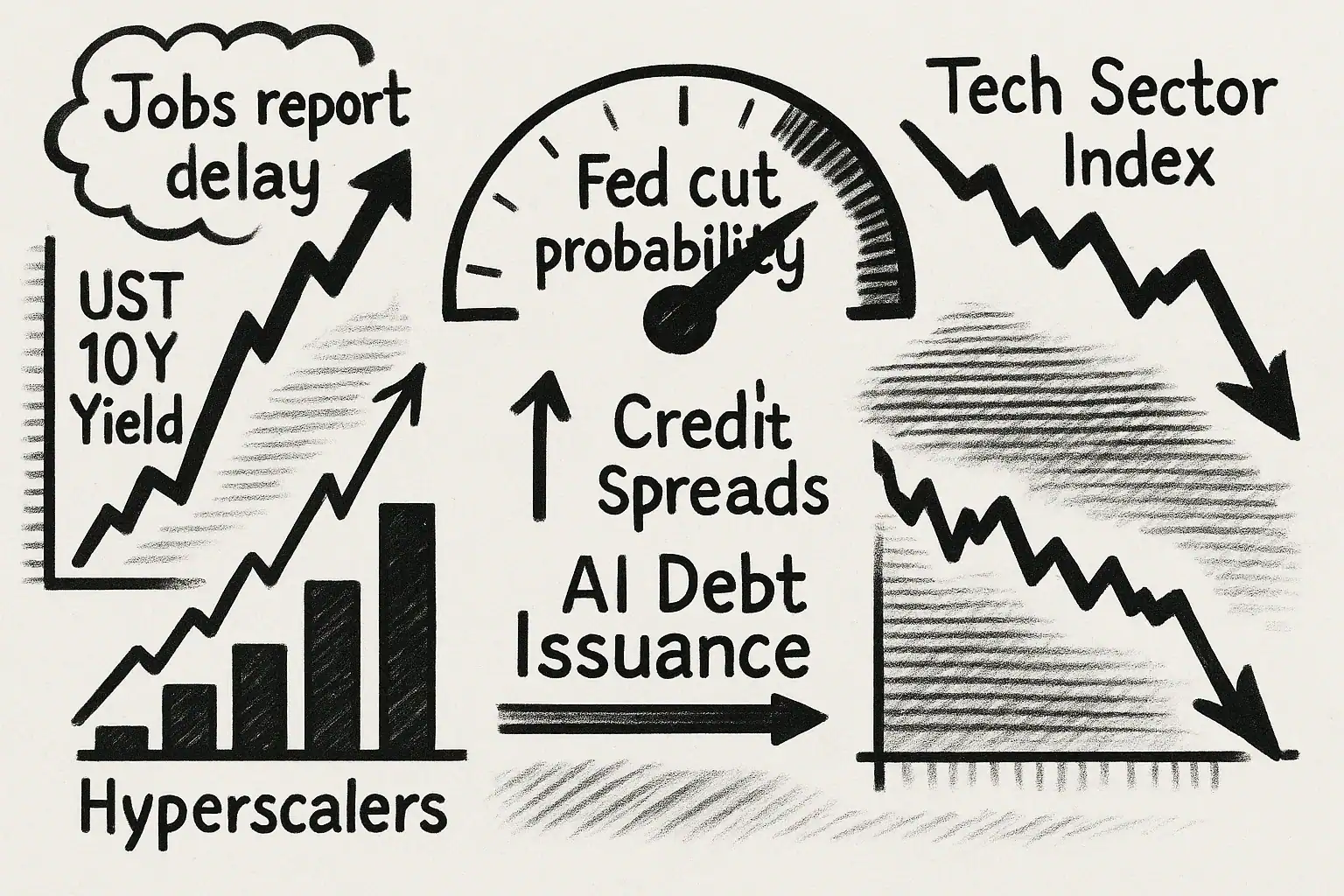
The market correction on November 20 2025 resulted from the convergence of a macroeconomic shock regarding labor data and structural credit risks within the technology sector.
A delayed September jobs report showing 119000 new payrolls diminished the probability of a December Federal Reserve rate cut thereby raising the cost of capital.
Concurrently record debt issuance by technology hyperscalers to fund AI infrastructure caused credit spreads to widen specifically for Oracle and Meta.
This environment triggered institutional degrossing where investors rotated capital out of the technology sector and into defensive assets such as consumer staples.
1. Macroeconomic Catalyst: Analysis of September 2025 Employment Data
1.1 Deviation from Consensus Forecasts
The release of the September Employment Situation Summary by the Bureau of Labor Statistics acted as a primary volatility trigger due to a significant divergence from market expectations. The data challenged the prevailing economic narrative by suggesting labor demand remained robust while labor supply dynamics introduced ambiguity.
- Nonfarm Payrolls: The US economy added 119,000 jobs in September surpassing the consensus forecast of approximately 55,000. Investing.com
- Unemployment Rate: The unemployment rate increased to 4.4% up from 4.3% in the previous month.
- Prior Revisions: Revisions to July and August data subtracted a cumulative 33,000 jobs indicating that trend growth prior to September was weaker than initially believed.
- Wage Growth: Average hourly earnings rose by 0.2% month-over-month slightly below the 0.3% forecast signaling potential disinflation despite hiring strength.
Definition: The Nonfarm Payrolls report is a monthly statistic representing the total number of paid workers in the US excluding farm employees government employees private household employees and nonprofit employees.
1.2 Data Integrity and the Government Shutdown
The reliability of the September report was influenced by the 43-day federal government shutdown which altered standard data collection timelines. While the high response rate suggests statistical robustness the delay created a temporal disconnect for investors.
- Response Rate Anomaly: The establishment survey response rate exceeded 80% which is the highest level recorded since 2019. Marketplace
- Delay Mechanism: The shutdown delayed the report release by approximately six weeks allowing non-responding firms additional time to submit payroll data.
Counterpoint: While the initial print is likely accurate due to the high response rate economists argue that the data is stale because it does not reflect the economic drag caused by the shutdown itself in October and November estimated to reduce Q4 GDP by 1.0% to 2.0% annualized. CBO Publication
1.3 Statistical Artifacts and Labor Composition
A structural divergence between the Establishment Survey and the Household Survey has complicated the interpretation of labor strength suggesting the headline numbers may overstate economic resilience.
- Immigration Impact: Recent declines in immigration rates due to stricter border enforcement in 2025 have impacted labor supply in specific sectors.
- Population Controls: Discrepancies in population estimates may artificially inflate native-born employment figures in the Household Survey to align with Census projections. PIIE Research
Definition: A Statistical Artifact in this context refers to a data distortion resulting from the methodology used to estimate population flows rather than a change in underlying economic activity.
1.4 Sectoral Imbalances and Defensive Hiring
The composition of job gains reveals that growth was not broad-based but concentrated in non-cyclical service-oriented sectors implying a stagflationary mix.
- Health Care: Added +43,000 jobs continuing a secular trend largely immune to interest rate policy.
- Food Services: Added +37,000 jobs reflecting the continued normalization of the service economy.
- Manufacturing: Shed -6,000 jobs signaling contraction in the goods-producing economy.
- Transportation & Warehousing: Lost -25,000 jobs a recessionary signal indicating slowing movement of goods. PBS NewsHour
2. Monetary Policy: Reassessment of the Federal Reserve Trajectory
2.1 Repricing of Interest Rate Expectations
The jobs report directly impacted the bond market pricing for the Federal Reserve December policy meeting neutralizing the Goldilocks scenario.
- Pre-Report Probability: Markets previously priced in a near-certainty approximately 97% of a rate cut.
- Post-Report Probability: Following the data release the implied probability of a cut fell to approximately 33% to 41%. CBS News
Definition: The Implied Probability is a percentage likelihood of a future event derived from the current pricing of financial instruments such as Fed Funds futures.
Therefore the bond market adjusted to a higher-for-longer interest rate regime. This adjustment mechanically lowered the present value of long-duration assets particularly in the technology sector.
2.2 The Neutralization of the Fed Put
Federal Reserve officials have maintained a data-dependent stance. The mixed nature of the September data coupled with the lack of October data due to the shutdown has likely forced policymakers to adopt a risk-averse posture regarding rate cuts.
Definition: The Fed Put is the market belief that the Federal Reserve will lower interest rates or inject liquidity to prevent a significant decline in equity markets.
Given the payroll beat the Federal Reserve lacks the justification to ease policy to support asset prices. As a result equity markets became more sensitive to valuation concerns without the backstop of monetary support.
3. Structural Risks: The AI Trade and Corporate Leverage
3.1 Escalation of Hyperscaler Debt Issuance
The technology sector has shifted from funding Artificial Intelligence infrastructure via free cash flow to utilizing debt financing representing a fundamental change in the business model.
- Total Issuance: Year-to-date in 2025 major hyperscalers including Amazon Google Meta Microsoft and Oracle have issued $121 billion in investment-grade debt.
- Q4 Volume: Since September 1 2025 these firms issued $81 billion in debt.
- Comparison: This volume represents a 4x increase over the five-year annual average for these issuers. LiveMint Report
Definition: Hyperscalers are large cloud service providers that offer massive computing and storage capacities typically dominating the data center market.
3.2 Credit Spread Widening
The influx of supply has saturated the investment-grade bond market leading to a widening of credit spreads for specific technology issuers signaling investor skepticism.
- Oracle (ORCL): Spreads widened by 48 basis points between September 1 and November 14 reflecting concerns over its aggressive debt-funded expansion.
- Meta Platforms (META): Spreads widened by 15 basis points over the same period.
- Alphabet (GOOGL): Spreads widened by 10 basis points. Janus Henderson Analysis
Definition: A Credit Spread is the difference in yield between a corporate bond and a risk-free government bond of the same maturity reflecting the perceived default risk of the issuer.
This widening indicates that bond investors are demanding a higher risk premium to hold technology debt. Because the cost of debt is rising the hurdle rate for AI capital expenditures has increased potentially pressuring future profit margins.
3.3 Capital Expenditure Intensity
The ratio of capital expenditure to operating cash flow for hyperscalers is projected to rise significantly raising questions about Return on Invested Capital (ROIC).
- Projected Ratio: AI-related CapEx is expected to reach 94% of operating cash flow net of buybacks and dividends in 2025 and 2026 up from 76% in 2024. IO Fund Analysis
Counterpoint: Analysts at Bank of America suggest that despite wider spreads the absolute level of yield remains attractive and companies like Microsoft continue to maintain robust balance sheets with minimal need for external funding.
4. Market Microstructure: Degrossing and Sector Rotation
4.1 Institutional Degrossing Dynamics
The market decline on November 20 was amplified by mechanical position adjustments by institutional investors rather than purely fundamental selling.
- Mechanism: Hedge funds reduced gross exposure by selling crowded long positions and covering short positions.
- Impact: This activity caused high-momentum stocks to underperform despite positive fundamental news such as Nvidia earnings beat.
Definition: Degrossing is a risk management process where a fund reduces both its long and short positions simultaneously to lower overall leverage and volatility exposure.
4.2 Sector Performance and Defensive Rotation
Sector performance data confirms a rotation from growth-sensitive sectors to defensive sectors driven by the higher rate outlook.
- Technology (XLK): Declined by 2.50% reflecting sensitivity to higher rates and degrossing.
- Consumer Discretionary (XLY): Declined by 0.94% sensitive to consumer health.
- Utilities (XLU): Declined by 0.17% significantly outperforming the broader market.
- Consumer Staples (XLP): Advanced by 0.73% acting as a safe haven. Sector SPDRs Tracker
The relative strength in Utilities and Consumer Staples indicates that investors prioritized capital preservation and current income over capital appreciation. Furthermore the resilience in Utilities is partly attributed to their role in supplying power for AI data centers creating a hybrid defensive-growth narrative.
Leave a Reply