
Executive Summary
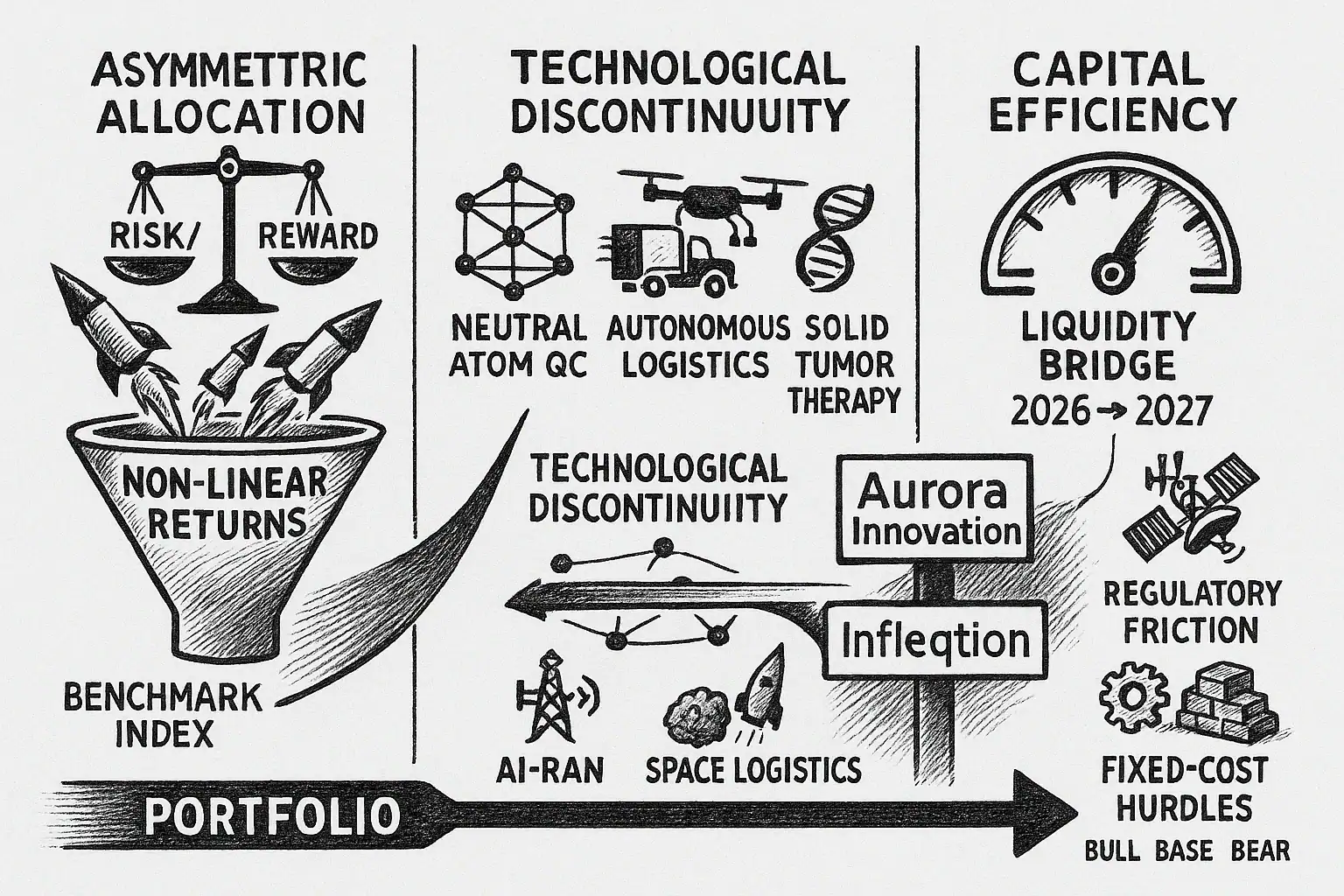
- The analyzed portfolio utilizes an Asymmetric Allocation strategy, concentrating capital in high-variance, pre-profit equities to target non-linear returns that exceed standard index benchmarks.
- Technological Discontinuity serves as the primary investment thesis, specifically within neutral atom quantum computing, autonomous logistics networks, and solid tumor cell therapies.
- Capital Efficiency remains the critical risk vector, as core holdings like Aurora Innovation and Infleqtion require substantial liquidity bridges to reach commercial contribution margins in 2026 and 2027.
- Strategic infrastructure bets on AI-RAN and space economy logistics provide uncorrelated diversification, though they remain subject to regulatory friction and high fixed-cost hurdles.
1. Structural Mechanics of Asymmetric Allocation
The Probability of Ruin in Concentrated Portfolios
Asymmetric Allocation is a portfolio construction methodology that prioritizes the magnitude of potential returns over the frequency of correctness. This approach diverges from Modern Portfolio Theory, which seeks to minimize volatility through broad diversification.
In an Asymmetric Allocation framework, the investor accepts a heightened probability of idiosyncratic failure—the permanent impairment of capital in specific holdings—in exchange for exposure to power-law return distributions.
The mechanics of this strategy rely heavily on the concept of positive skewness. In a standard Gaussian distribution, returns are symmetrically distributed around a mean.
However, the returns of the selected assets (micro-cap disruptors) exhibit fat tails, where the probability of extreme positive outcomes is higher than a normal distribution would predict. The risk in Asymmetric Allocation is not volatility, but rather sequencing risk.
If negative tail events occur early in the compounding phase, the capital base may degrade below the threshold required to recover, regardless of subsequent successes in other positions. This necessitates a rigorous focus on Capital Efficiency to ensure that holding periods do not exceed the solvency runways of the underlying assets.
Macro-Strategic Environment and Valuation Compression
The 2025 market environment provides a specific backdrop for Asymmetric Allocation due to the extreme valuation dispersion between mega-cap incumbents and small-cap challengers.
The top constituents of the S&P 500 account for approximately 35 percent of the index weight(https://www.fool.com/research/magnificent-seven-sp-500/), creating a concentration risk within passive indices themselves. Conversely, the micro-cap sector has experienced valuation compression, where companies are priced near their cash values or at low multiples of future sales.
Technological Discontinuity acts as the catalyst for mean reversion in this environment. As interest rates stabilize or decline in late 2025, the discount rates applied to long-duration assets—companies whose cash flows are weighted toward the distant future—compress.
This mechanical repricing benefits pre-profit growth stocks disproportionately compared to cash-rich incumbents. The portfolio leverages this dynamic by targeting assets that are currently mispriced due to short-term liquidity concerns or regulatory uncertainty, betting that Capital Efficiency improvements and technological milestones will trigger a repricing event.
2. Quantum Computing and Technological Discontinuity
Neutral Atom Physics vs. Superconducting Modalities
Technological Discontinuity in the quantum computing sector is driven by the shift from superconducting circuits to neutral atom modalities. Infleqtion, the target company within the Churchill Capital Corp X (CCCX) vehicle, utilizes neutral atoms trapped in optical lattices.
Neutral atom quantum computing is a hardware approach that uses lasers to cool and trap individual atoms in a vacuum to serve as qubits.
Unlike superconducting circuits which require complex cryogenic wiring for every individual qubit, neutral atom systems allow for the manipulation of large arrays of atoms using a limited number of optical control fields.
This intrinsic scalability addresses the connectivity bottlenecks that have plagued early quantum competitors. Infleqtion has demonstrated a 1,600 physical qubit array with 99.73 percent entangling fidelity(https://www.otcmarkets.com/stock/CCCX/news/Infleqtion-to-Go-Public-Through-Merger-with-Churchill-Capital-Corp-X?e&id=3309919), establishing a clear technical moat. The ability to scale qubit counts without a linear increase in control hardware represents a significant improvement in Capital Efficiency regarding hardware development costs.
Capital Market Structure: The SPAC Vehicle and Valuation
The investment in Infleqtion via a Special Purpose Acquisition Company (SPAC) introduces distinct structural risks and opportunities characteristic of Asymmetric Allocation. The merger values Infleqtion at a pro-forma enterprise value of $1.8 billion Infleqtion Investor Presentation.
SPAC Arbitrage in this context refers to the exploitation of the disconnect between the net asset value of the trust and the potential post-merger equity value. The transaction includes a committed PIPE (Private Investment in Public Equity) of over $125 million, which acts as a backstop to ensure sufficient capitalization post-close.
This structure is designed to mitigate the redemption risk that often plagues de-SPAC transactions. Furthermore, the dual-track revenue model of Infleqtion—generating $29 million in TTM revenue from quantum sensing products like the Tiqker atomic clock(https://stocktitan.net/sec-filings/CCCX/)—provides a floor that pure-play compute peers lack. This revenue stream enhances the Capital Efficiency of the firm, reducing reliance on external capital markets during the volatile de-SPAC period.
3. Autonomous Logistics and Commercial Scalability
Driver-as-a-Service Model Economics
Aurora Innovation (AUR) exemplifies the application of Technological Discontinuity to the logistics sector through its Driver-as-a-Service (DaaS) business model. This model shifts the economic unit of the trucking industry from a labor-constrained asset to a software-defined service.
Driver-as-a-Service is a commercial framework where the autonomous technology provider charges a per-mile fee to fleet operators for the use of the autonomous driving software, rather than selling the trucks outright. This approach aligns the revenue scaling directly with mileage accumulation rather than hardware sales cycles. Aurora has recently commenced commercial driverless operations on public roads in Texas, a critical validation of this model(https://ng.investing.com/news/company-news/aurora-innovation-q2-2025-slides-reveal-commercial-driverless-trucking-milestone-amid-losses-93CH-2179827). The transition to commercial operations allows for the recognition of high-margin software revenue, which is essential for proving the long-term Capital Efficiency of the platform.
Competitive Landscape and Capital Efficiency
The autonomous trucking sector has undergone consolidation, leaving a triopoly of Aurora, Kodiak Robotics, and Waabi. Each competitor approaches the challenge of Capital Efficiency differently.
- Aurora Innovation: Holds approximately $1.6 billion in liquidity, providing a runway into the second half of 2027 Aurora Liquidity. However, with quarterly operating losses exceeding $220 million, the company must rapidly scale revenue to avoid dilutive financing.
- Kodiak Robotics: Recently public via a SPAC merger with Ares Acquisition Corp II, Kodiak focuses on a lean hardware stack to maximize Capital Efficiency. They have deployed 10 driverless trucks and achieved over 5,200 paid driverless hours in Q3 2025(https://investors.kodiak.ai/news-releases/news-release-details/kodiak-ai-announces-third-quarter-2025-results).
- Waabi: Utilizes a generative AI simulation approach to reduce the need for extensive real-world testing miles. Their partnership with Volvo and upcoming 2025 launch positions them as a direct challenger to Aurora(https://www.techbuzz.ai/articles/waabi-unveils-fully-autonomous-truck-with-volvo-takes-aim-at-aurora).
For an Asymmetric Allocation strategy, Aurora represents the high-beta bet on the pure-play leader. The risk is that competitor approaches like Waabi’s simulation-first method prove to be more capital efficient, eroding Aurora’s first-mover advantage.
4. Biotechnology and Commercial Execution
Cell Therapy Manufacturing Logistics
Iovance Biotherapeutics (IOVA) introduces Technological Discontinuity to oncology through the commercialization of Tumor Infiltrating Lymphocyte (TIL) therapies. The operational complexity of this modality makes manufacturing logistics a primary driver of valuation.
Autologous Cell Therapy Manufacturing is the process of harvesting a patient’s own immune cells, transporting them to a central facility for expansion and activation, and returning them for re-infusion.
This bespoke supply chain historically limits Capital Efficiency due to high variable costs. However, Iovance reported Q3 2025 net product revenue of $67.4 million with a gross margin of 43 percent Iovance Q3 2025 Financials.
The centralization of production at the Iovance Cell Therapy Center (iCTC) is a strategic move to vertically integrate the supply chain, thereby improving unit economics and accelerating the path to profitability.
Clinical Label Expansion as Value Driver
The Asymmetric Allocation thesis for Iovance relies on label expansion beyond the initial melanoma indication. The approved product, Amtagvi, serves as the proof of concept. The true value inflection point lies in the application of TIL therapy to Non-Small Cell Lung Cancer (NSCLC).
Label Expansion refers to the regulatory approval of an existing drug for additional disease indications. This process dramatically increases the Total Addressable Market (TAM) with significantly lower R&D risk compared to de novo drug discovery. Iovance is currently enrolling for the IOV-LUN-202 trial in NSCLC, with data expected in 2026 Iovance Pipeline Update.
Success in this indication would represent a massive Technological Discontinuity in lung cancer treatment standards, likely triggering a repricing of the asset. The company cash position of $307 million provides a runway to these data readouts, maintaining Capital Efficiency by avoiding premature dilution.
5. Strategic Infrastructure and Special Situations
AI-RAN and Telecommunications Convergence
Nokia (NOK) has emerged as a critical infrastructure play within the Asymmetric Allocation portfolio following a strategic investment by Nvidia. This partnership focuses on the development of AI-RAN (Artificial Intelligence Radio Access Network).
AI-RAN is a network architecture that unifies wireless connectivity and AI computing infrastructure onto a single platform. Instead of separate silos for telecommunications and data processing, AI-RAN allows the network edge to perform inference tasks. Nvidia’s $1 billion investment for a 2.9 percent stake in Nokia Nokia Nvidia Investment validates this Technological Discontinuity.
This move positions Nokia not just as a hardware vendor, but as a platform provider for the AI economy, potentially creating a new recurring revenue model that offers superior Capital Efficiency compared to traditional CAPEX-heavy telecom cycles.
Regulatory Arbitrage in Education and Space
The portfolio includes special situations where regulatory outcomes determine the viability of the Asymmetric Allocation.
- Stride Inc. (LRN): The stock has suffered due to allegations of enrollment fraud and the expiration of ESSER funding. The thesis is a mean-reversion trade based on the company P/E ratio dropping below 10x(https://www.macrotrends.net/stocks/charts/LRN/stride/pe-ratio). However, the breakdown in internal controls represents a severe failure of operational Capital Efficiency, raising the risk of ruin.
- Space Economy (RKLB/ASTS): Rocket Lab (RKLB) and AST SpaceMobile (ASTS) operate in a sector with extreme barriers to entry. Rocket Lab’s Neutron rocket aims to break the SpaceX monopoly, offering a Technological Discontinuity in medium-lift launch capabilities. AST SpaceMobile faces binary technical risk in establishing direct-to-device connectivity. ASTS holds $1.2 billion in cash but missed revenue targets(https://payloadspace.com/rocket-lab-ast-spacemobile-post-q3-results/), highlighting the tension between immense capital requirements and the timeline to commercialization.
6. Synthesis of Risk and Return
The constructed portfolio exhibits a bimodal outcome distribution characteristic of Asymmetric Allocation. The simultaneous exposure to Technological Discontinuity in three distinct physical domains—quantum mechanics, autonomous robotics, and cellular biology—provides diversification of technical risk, even while financial risk remains correlated to the cost of capital.
Capital Efficiency acts as the master variable. In a high-rate environment, the burn rates of Aurora and Infleqtion would necessitate punitive dilution, potentially destroying shareholder equity even if the technology succeeds. Conversely, in the projected easing cycle of late 2025, these companies can bridge to profitability, allowing the Power Law of returns to function.
The investor must monitor liquidity runways quarterly to manage the probability of ruin, ensuring that the Asymmetric Allocation remains a calculated strategy rather than a gamble.
Leave a Reply