
Executive Summary
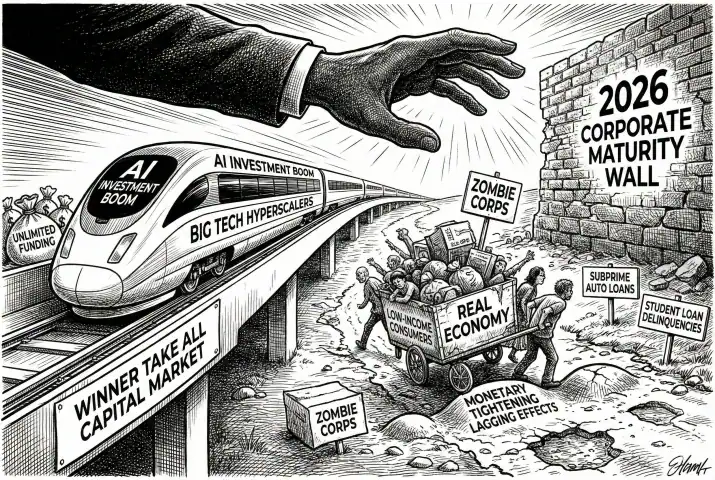
- The global economy is undergoing a “Great Bifurcation,” where the lagging effects of monetary tightening are causing acute distress for low-income consumers and “zombie” corporations, while a massive AI investment boom by Big Tech masks these structural weaknesses.
- Critical signs of financial strain have emerged in the “real economy,” characterized by surging delinquencies in subprime auto and student loans, alongside a looming 2026 corporate maturity wall that threatens the survival of firms unable to cover interest expenses.
- This two-speed dynamic creates a “Winner Take All” capital market where hyperscalers secure unlimited funding for AI infrastructure, effectively crowding out smaller borrowers and leaving the broader cyclical economy vulnerable to a potential recessionary feedback loop.
1. The Monetary Transmission Mechanism: From Policy to Pain
To understand the current economic reality, one must first grasp the mechanics of monetary policy transmission. The central bank’s decision to raise or lower interest rates is merely the starting signal; the actual impact on the economy is determined by how commercial banks interpret those signals and adjust their lending behavior. This process is notoriously slow, characterized by what economist Milton Friedman famously called ‘long and variable lags.’ In 2025, we are living through the tail end of these lags from the tightening cycle that began years prior.
1.1 The Senior Loan Officer Opinion Survey (SLOOS) as a Leading Indicator
The Federal Reserve’s Senior Loan Officer Opinion Survey (SLOOS) acts as the most critical barometer for the health of the banking channel. Unlike interest rates, which tell us the price of money, the SLOOS tells us about the availability of money. It measures whether banks are making it harder or easier for businesses and consumers to get loans, regardless of the interest rate.
1.1.1 The Persistence of Tight Standards
Throughout 2024 and extending into late 2025, the banking sector has maintained a posture of defensiveness. Data indicates that bank lending standards have remained at the tighter end of their historical ranges. This is a significant deviation from typical mid-cycle behavior, where banks usually compete aggressively for market share by loosening standards. Instead, we see a sustained period where banks are risk-averse.
The drivers of this tightening are multifaceted. First, banks are citing ‘reduced risk tolerance’. Following the regional banking turbulence of 2023—which saw the collapse of institutions like Silicon Valley Bank due to duration mismatches—banks have become hyper-sensitive to liquidity preservation. They are less willing to extend long-term credit or lend to borrowers with imperfect credit histories. Second, the economic outlook itself remains uncertain. When banks anticipate a potential slowdown, they preemptively tighten standards to shield their balance sheets from future defaults. This creates a self-fulfilling prophecy: by restricting credit, they starve the economy of the fuel it needs to grow, thereby increasing the probability of the very slowdown they fear.
1.1.2 Sector-Specific Tightening
The tightening is not uniform; it is surgical. Significant net shares of banks have reported standards at the tighter ends of their ranges specifically for subprime credit card loans, subprime auto loans, and Commercial and Industrial (C&I) loans to smaller firms. This confirms that the credit crunch is asymmetric. Large, investment-grade corporations (which we will discuss in the context of AI) still have ample access to capital markets. In contrast, the consumer with a lower credit score or the small business relying on bank lines of credit is facing a credit environment that is functionally recessionary.
For beginner observers, it is crucial to understand that ‘tightening standards’ means higher collateral requirements, lower loan-to-value ratios, and more stringent income verification processes. Even if the Federal Reserve were to cut interest rates tomorrow, if banks do not relax these standards, the flow of credit to the real economy would remain constricted.
1.2 The Lag Effect: Historical Analysis vs. Present Reality
A key area of debate among economists is how long it takes for rate hikes to ‘bite.’ Historical analysis by the Chicago Fed suggests that financial conditions typically adjust to policy tightening with a delay. They utilize linear regression models to project the path of financial variables based on past tightening cycles. Their findings offer a nuanced view: there is little evidence that the pass-through of policy rates to financial conditions has been ‘unusually weak’ in this cycle.
This finding is critical because it counters the narrative that the economy has become immune to interest rates. Instead, it suggests that the transmission mechanism is working exactly as intended, just slowly. The ‘reassurance’ provided by this analysis is that the tighter policy of the last two and a half years is indeed acting to reduce inflation. However, the flip side of this reassurance is that the economic drag—the slowing of growth and the rise in unemployment—is also still working its way through the system.
Furthermore, research from the Richmond Fed highlights a synchronization anomaly in the current cycle. Historically, peaks in the two-year Treasury yield (a market proxy for Fed expectations) occur several quarters before peaks in SLOOS credit tightening. However, in the recent episode, credit tightening responded much faster, rising in tandem with yields. This suggests that banks were more reactive this time, likely spooked by the speed of the rate hikes and the instability in the banking sector. Despite this rapid reaction in standards, the economic consequences (like GDP slowdowns) typically follow the SLOOS tightening by several quarters. Therefore, the restrictive lending environment of 2024-2025 is a leading indicator for economic weakness in 2026.
1.3 Demand Destruction: The Other Side of the Coin
Credit formation requires two parties: a willing lender and a willing borrower. The SLOOS data reveals a deterioration on both sides of this equation. While banks are tightening supply, businesses and consumers are also reducing demand.
Significant net shares of banks have cited ‘customers’ decreased accounts receivable financing needs,’ ‘lower precautionary demand for cash and liquidity,’ and ‘higher internally generated funds’ as reasons for weaker loan demand. This is a classic late-cycle signal. When companies stop borrowing to expand operations or build inventory, it signals a lack of confidence in future growth. They are retreating to a defensive crouch, relying on their own cash piles rather than leveraging up for expansion. This reduction in credit demand is a precursor to a slowdown in capital investment (outside of AI) and hiring.
2. The Bifurcated Consumer: Erosion from the Bottom Up
The United States consumer has long been the engine of the global economy, accounting for roughly 70% of US GDP. However, the aggregate data on consumer health is masking a deep divide. We are witnessing a ‘K-shaped’ dynamic where asset-rich households (homeowners with stock portfolios) are thriving, while income-dependent households (renters with variable rate debt) are facing an acute liquidity crisis.
2.1 The Delinquency Surge: A Structural Shift
By the third quarter of 2025, the signs of consumer distress had moved beyond anecdotal evidence to become statistically significant trends in Federal Reserve data. While year-over-year changes in delinquency rates appeared to decelerate from their peaks, the absolute levels of financial stress remain elevated and, in some specific categories, are worsening.
2.1.1 Auto Loans: The Canary in the Coal Mine
In the hierarchy of consumer payments, the auto loan is paramount. For most Americans, a car is essential for employment. Therefore, consumers will typically prioritize their car payment over credit cards or even mortgages in times of stress. When auto loan delinquencies rise, it is a severe signal of distress.
Data from the New York Fed indicates that auto loan delinquencies have ‘picked up’ specifically for lower-income households in the third quarter of 2025. While the seasonally adjusted rate was flat earlier in the year, the transition into serious delinquency (90+ days past due) reached 2.93% in Q2 2025 and continued to inch up to 2.99% in Q3 2025. This is nearly 3% of all auto balances transitioning into default status in a single quarter—a rate that rivals periods of significant economic stress.
The ‘subprime’ nature of this stress is confirmed by the banking data. Significant shares of banks reported tightening standards specifically for subprime auto loans. This indicates that lenders are effectively closing the window for lower-income borrowers, forcing them into the arms of predatory lenders or pricing them out of vehicle ownership entirely.
2.1.2 The Credit Card Trap
Credit card balances have ballooned to $1.23 trillion as of late 2025. This expansion is not driven by healthy confidence but by necessity. Households are using revolving credit to bridge the gap between their wages and the cumulative inflation of the past three years.
The flow into serious delinquency for credit cards has stabilized at a dangerously high plateau, hovering around 7% (6.93% in Q2 2025, 7.05% in Q3 2025). To put this in perspective, this is significantly higher than the pre-pandemic norms. It suggests that a substantial portion of the population—likely the bottom 40% by income—has exhausted their savings buffers and is now defaulting on unsecured debt.
The mechanism here is the ‘interest rate shock.’ Most credit cards have variable interest rates. As the Fed raised rates, the Annual Percentage Rate (APR) on credit cards surged to over 20-25%. This means that for a household carrying a balance, the cost of servicing that debt has doubled, consuming a larger share of disposable income and crowding out consumption of other goods.
2.1.3 The Student Loan Shock
Perhaps the most startling statistic in the 2025 data is the explosion in student loan delinquencies. For years, student loan delinquencies were artificially suppressed due to government forbearance programs related to the pandemic. As these programs expired and the ‘on-ramp’ periods ended, the reality of the debt burden resurfaced.
The transition rate into serious delinquency for student loans jumped from a benign 0.80% in Q2 2024 to a staggering 12.88% in Q2 2025, and further to 14.26% in Q3 2025. This is not a gradual increase; it is a shock. It represents millions of younger borrowers (Millennials and Gen Z) suddenly having their credit scores impaired. This has long-term ripple effects: a borrower in default on student loans cannot qualify for a mortgage, further depressing the housing market turnover, and may struggle to pass employment credit checks.
2.2 Housing Wealth: A False Security?
The narrative of consumer resilience often leans on the ‘wealth effect’ from housing. With home prices remaining high, homeowners feel wealthier. However, this wealth is illiquid. To access it, one must sell (incurring transaction costs and losing a low mortgage rate) or borrow against it (HELOC).
The data suggests that borrowing against home equity is becoming increasingly perilous. The transition into delinquency for Home Equity Lines of Credit (HELOCs) more than doubled from 0.51% in 2024 to 1.15% in 2025. In Q3 2025, it reached 1.27%. This indicates that households that are trying to tap into their housing piggy banks to solve liquidity problems are finding themselves unable to service the new, higher-rate debt. It challenges the assumption that high home equity levels will insulate the economy from a consumer downturn.
| Debt Category | Q2 2024 Serious Delinquency Flow | Q2 2025 Serious Delinquency Flow | % Change | Implication |
|---|---|---|---|---|
| Mortgage Debt | 0.95% | 1.29% | +35% | Rising, but remains low relative to history. |
| HELOC | 0.51% | 1.15% | +125% | Severe stress in home equity borrowing. |
| Auto Loans | 2.88% | 2.93% | +1.7% | Structurally high; subprime crisis unfolding. |
| Credit Cards | 7.18% | 6.93% | -3.5% | Stabilizing at a very high, recessionary level. |
| Student Loans | 0.80% | 12.88% | +1510% | Policy shock; younger demographic impaired. |
3. The Corporate Maturity Wall and the ‘Zombie’ Apocalypse
While consumers grapple with high interest rates, the corporate sector faces a ticking clock known as the ‘Maturity Wall.’ During the years of zero interest rates (2020-2021), corporations gorged on cheap debt, issuing bonds with 3-to-5-year maturities. As we approach 2026 and 2028, these bills are coming due.
3.1 The Anatomy of the Wall (2026-2028)
Global corporate maturities are set to rise swiftly, peaking at $3.02 trillion in 2028. This wave of maturing debt includes nearly $1.0 trillion in speculative-grade (High Yield or ‘Junk’) bonds and loans. The fundamental risk here is not just the amount of debt, but the cost of refinancing it.
A company that issued a bond in 2021 might have paid a coupon of 4%. When that bond matures in 2026, they will likely have to issue a new bond to pay off the old one. In the current environment, investors might demand a yield of 8% or 9%. This doubling of interest expense flows directly to the bottom line, crushing profit margins. For a healthy company, this is painful. For a weak company, it is fatal.
3.2 The Rise of the Zombie Companies
This refinancing risk brings into focus the phenomenon of ‘Zombie Companies.’ These are firms that are economically stagnant—they generate enough cash to keep the lights on and pay employees, but not enough to cover their interest expenses. They survive only by borrowing more money to pay off the interest on existing debt, a behavior akin to ‘burning the furniture to heat the house.’
3.2.1 Prevalence and Persistence
Estimates vary, but the scale of the problem is significant. As of late 2024, approximately 15% of the companies in the Russell 3000 (a broad US equity index) were considered zombies. Other analyses suggest the number is even higher, with nearly one-third of Russell 3000 firms being unprofitable and over 650 companies unable to cover interest expenses.
These companies have survived because capital was essentially free. In a world of 5% risk-free rates, they are economic anomalies. As the maturity wall hits in 2026, these firms face a binary outcome: restructure (bankruptcy) or liquidation. The survival of these firms distorts the economy; they trap capital and labor in unproductive uses, lowering overall economic productivity.
3.2.2 The ‘Extend and Pretend’ Game
Throughout 2025, corporate treasurers engaged in a strategy of ‘extend and pretend.’ They aggressively refinanced debt ahead of schedule to push maturities out to 2028 or beyond. Data shows that non-financial corporates reduced their 2026 speculative-grade maturities by 33% in the first nine months of 2025.
While this reduces the immediate risk of a 2026 crisis, it merely concentrates the risk in 2028. It creates a higher, steeper wall in the future. Furthermore, this strategy was only available to ‘better’ junk companies (rated B or BB). The lowest-rated companies (CCC rated) have largely been unable to refinance. The amount of CCC debt maturing in 2026 is now more than double the amount of B- rated debt. This creates a ‘cliff edge’ for the riskiest assets.
3.3 High Yield vs. Investment Grade: The Great Divergence
The corporate bond market is not a monolith. It is deeply bifurcated between Investment Grade (IG) issuers—companies with strong balance sheets like Microsoft or Johnson & Johnson—and High Yield (HY) issuers.
Investment Grade: These companies are resilient. They have pricing power and can pass on higher interest costs to consumers. In fact, 2025 saw record issuance from IG companies. Investors, seeking safety and yield, have flocked to these bonds, keeping spreads (the risk premium) historically tight.
High Yield: This segment is fragile. The lowest tier (CCC) is showing signs of cracking. The median price for a CCC bond maturing within 12 months has dropped to 93.3 cents on the dollar, a sign that the market expects defaults. Default rate forecasts for leveraged loans are projected to rise to 7.9% in Q1 2026.
This divergence suggests that while the ‘headline’ stock market (dominated by IG companies) may look healthy, the ‘engine room’ of the economy (smaller, leveraged companies) is deteriorating.
4. The AI Capital Expenditure Super-Cycle: Distortion and Opportunity
While traditional credit metrics signal caution, a countervailing force of massive magnitude is distorting the global economic picture: the Artificial Intelligence (AI) investment boom. This is the ‘Second Engine’ of the bifurcated economy.
4.1 The Scale of the Spend
The ‘Hyperscalers’—the small group of massive technology companies including Amazon, Alphabet (Google), Meta, Microsoft, and Oracle—are engaged in an arms race to build the infrastructure of the AI age. This involves building massive data centers, purchasing millions of GPUs (chips), and securing gigawatts of energy.
The numbers are staggering. Consensus estimates for Hyperscaler capital expenditure (Capex) in 2026 have risen to $518 billion. To put this in context, this level of spending is approaching the intensity of the 5G telecom buildout or the electrification of the early 20th century. Some analysts estimate that AI-related Capex alone accounts for 1.2% of US GDP.
This spending acts as a massive fiscal stimulus. It creates demand for construction, engineering, semiconductors, and energy, effectively propping up GDP numbers that might otherwise be negative due to the consumer and industrial slowdowns discussed earlier.
4.2 From Cash to Debt: The Funding Shift
A critical development in late 2025 was the shift in how this spending is funded. Historically, Big Tech companies were cash-rich and debt-averse, funding their growth out of free cash flow. However, the sheer scale of the AI buildout has exceeded even their massive cash generation capabilities.
In late 2025, we witnessed a ‘Bond Blitz.’ Alphabet raised $17.5 billion (plus €6.5 billion in Europe), Meta raised $30 billion, Amazon raised $15 billion, and Oracle raised $18 billion. These are massive issuances. These companies are leveraging their pristine balance sheets to lock in capital while they can.
4.3 The ‘Crowding Out’ Risk
This flood of high-quality debt has a side effect: ‘Crowding Out.’ Global investors have a finite appetite for corporate bonds. When Meta and Amazon come to market with billions of dollars of AAA-rated paper yielding 5%, they soak up a massive amount of the available liquidity.
This leaves less capital available for the rest of the market—the industrial companies, the retailers, and the lower-rated issuers. To attract investors, these ‘regular’ companies must offer significantly higher yields (wider spreads). This effectively raises the cost of capital for the broader economy. We are seeing a ‘Winner Take All’ dynamic in capital markets, where the AI giants get unlimited funding, and the zombie firms are starved.
4.4 Historical Parallels: Dot-Com Redux?
The intensity of this investment cycle has drawn comparisons to the Dot-Com bubble of the late 1990s.
The Overbuild Risk: History teaches that infrastructure booms often lead to overcapacity. The railroad boom of the 19th century and the fiber optic boom of the 1990s both ended in crashes where the infrastructure was built, but the immediate demand was insufficient to pay for it. If AI monetization (revenue from AI products) lags behind the Capex, these companies could face massive depreciation charges that crush earnings.
Circular Financing: Concerns have also emerged regarding ‘circular financing’. This occurs when a tech giant invests billions in an AI startup (e.g., Microsoft investing in OpenAI, or Amazon in Anthropic), and that startup uses the money to buy cloud services back from the investor. This inflates revenue figures and creates a feedback loop that looks stable until the capital injection stops.
However, proponents argue this time is different. Unlike the dot-com era, the Hyperscalers are hugely profitable, funding 80-90% of this Capex from operating cash flow. They are not speculative startups; they are the most profitable enterprises in human history.
5. 2026 Outlook: Scenarios and Strategies
As we look toward 2026, the global economy sits at a crossroads determined by the interaction of these opposing forces: the drag of high rates on consumers/zombies versus the lift of AI investment.
5.1 The ‘Grind’ Scenario (Base Case)
The most likely outcome is not a sudden crash, but a ‘Grind.’
Growth: GDP growth remains positive but below trend (e.g., 1-1.5%), kept afloat by AI spending and high-end consumer spending.
Credit: Default rates rise steadily, not explosively. We see a ‘cleansing’ of the corporate sector where zombie firms slowly file for bankruptcy or are acquired for parts.
Spreads: Credit spreads widen as investors demand more compensation for risk. The gap between Investment Grade and High Yield performance widens further (Decompression).
Monetary Policy: The Fed cuts rates, but slowly. The ‘neutral rate’ proves to be higher than in the past, meaning we do not return to ZIRP (Zero Interest Rate Policy).
5.2 The ‘Crowding Out’ Crash (Bear Case)
A more dangerous scenario involves a liquidity crisis in the bond market.
Trigger: A massive volume of maturities hits in 2026 at the same time Big Tech continues to issue debt.
Mechanism: The market suffers ‘indigestion.’ There simply isn’t enough cash to refinance the zombies. Spreads on CCC debt blow out to distressed levels (>1000 basis points).
Result: A wave of defaults in the ‘real economy’ (manufacturing, retail, services) triggers a rise in unemployment, which then topples the fragile subprime consumer, creating a feedback loop of recession.
5.3 Global Divergences
Europe: The European economy, lacking the same AI dynamism as the US, faces a harder road. With lower growth, the ECB may be forced to cut rates faster than the Fed. This would weaken the Euro and potentially export inflation to the US via a strong dollar.
Asia: The APAC region remains heavily reliant on refinancing. While refinancing volumes are healthy, the region is sensitive to US dollar strength.
5.4 Conclusion
For the global observer, the lesson of 2025-2026 is that ‘The Average’ is dead. One cannot look at ‘average GDP’ or ‘average consumer health’ and understand the risks. The risks are concentrated in the tails: the subprime consumer, the zombie corporation, and the speculative fringe. Conversely, the growth is concentrated in the head: the AI hyperscaler and the asset-rich homeowner. Navigating this environment requires distinguishing between the AI Economy (which is booming) and the Cyclical Economy (which is breaking). The transition in 2026 will be defined by how much the pain in the latter can be contained by the productivity of the former.
6. Comprehensive Data Appendix
Table 2: The Consumer Credit Bifurcation Matrix
Analysis of Q3 2025 Trends by Household Segment
| Metric | Prime / High Income | Subprime / Low Income | Systemic Risk Level |
|---|---|---|---|
| Asset Holdings | High (Equities, Real Estate) | Low / Negligible | High (Wealth Inequality) |
| Mortgage Status | Fixed at <4% (Locked in) | Renting (Rising Costs) | Medium (Housing Lock-in) |
| Auto Loans | Performing well | Delinquency rising (2.93%+) | High (Mobility Crisis) |
| Credit Cards | Paid in full monthly (Rewards) | Revolving balances (20%+ APR) | Critical (Debt Trap) |
| Inflation Impact | Manageable inconvenience | Existential crisis | High (Social Stability) |
Synthesized from NY Fed and SLOOS Data
Table 3: The ‘Maturity Wall’ Timeline
| Timeframe | Corporate Action | Market Condition |
|---|---|---|
| 2020-2021 | Issuance: Record borrowing at near-zero rates. | ‘Free Money’ Era. |
| 2022-2024 | Hiking: Fed raises rates; Companies use cash buffers. | The ‘Lag’ Period. |
| 2025 | Pre-financing: IG and strong HY firms refinance early. | ‘Extend and Pretend.’ |
| 2026 | The Cliff: CCC-rated debt matures; Refi options dry up. | Danger Zone. |
| 2028 | The Peak: $3.02 Trillion matures. | The Structural Test. |
Based on S&P Global and Moody’s Data
Table 4: The AI Investment Scale vs. Economy
| Entity | 2026 Capex Estimate | Context / Comparison |
|---|---|---|
| Hyperscalers (Total) | ~$518 Billion | > GDP of many mid-sized nations (e.g., Austria). |
| AI Capex % of GDP | ~1.2% | Comparable to historical major infrastructure booms. |
| Debt Issuance (late ’25) | >$75 Billion (Top 4 Firms) | Crowds out ~15-20% of monthly IG supply. |
| Funding Source | 80-90% Cash Flow | High quality, unlike Dot-com era debt. |
Leave a Reply