
Key Takeaways
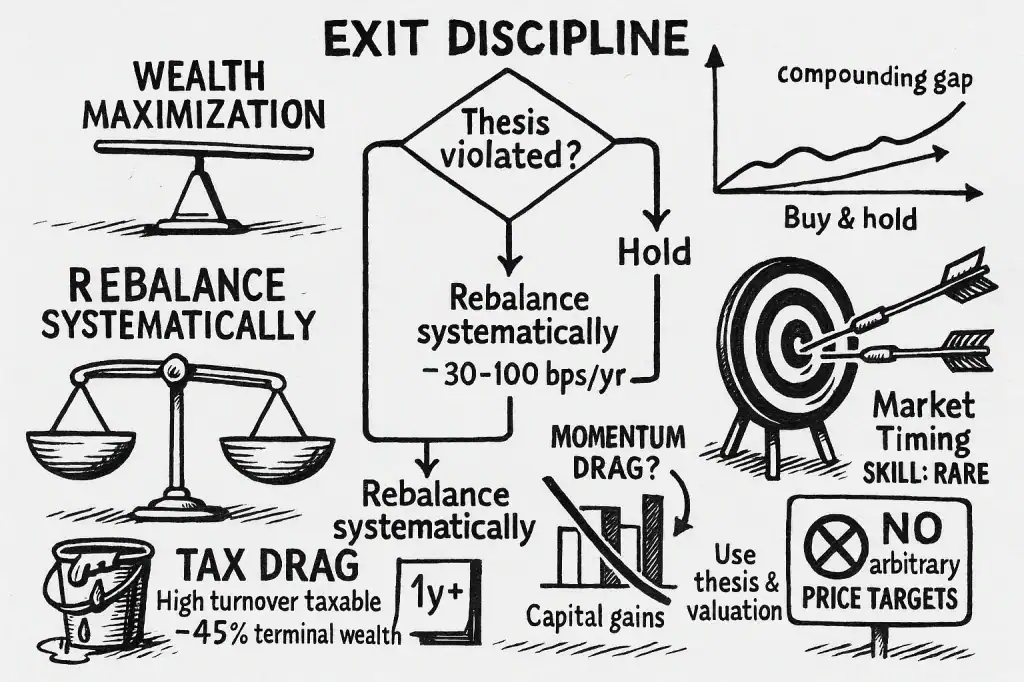
An effective investment exit strategy balances the mathematical objective of wealth maximization with the psychological necessity of regret minimization. Systematic portfolio rebalancing can generate a premium of approximately 30 to 100 basis points annually by harvesting volatility, though this must be weighed against momentum factors. Tax drag significantly erodes returns in taxable accounts, where high-turnover strategies can reduce terminal wealth by over 45 percent compared to tax-deferred buy-and-hold approaches. Institutional data indicates that consistent market timing is statistically rare; therefore, exit decisions should be driven by thesis violations rather than arbitrary price targets.
1. Introduction to Investment Exit Strategy and Asymmetry
In the discipline of asset management, a profound asymmetry exists between entry and exit decisions. The decision to acquire an asset is typically an act of forward-looking optimism based on fundamental discovery. However, the investment exit strategy is frequently a retrospective act, influenced by the psychological weight of accumulated gains and the fear of reversal.
A robust investment exit strategy defines the specific conditions under which an investor liquidates a position. This report analyzes the conflict between protecting paper profits and maximizing long-term compounding. It synthesizes data on volatility harvesting, tax efficiency, and behavioral economics to construct a framework for the exit decision that transcends binary buy or sell debates.
2. Behavioral Foundations of the Investment Exit Strategy
To evaluate profit-taking rules, one must understand the psychological machinery driving them. The urge to liquidate winning positions is often a defense mechanism against the emotional pain of loss rather than a calculated financial optimization.
2.1 The Disposition Effect in Exit Decisions
The anxiety regarding profits turning into losses is a manifestation of the Disposition Effect. The Disposition Effect is the tendency of investors to sell assets that have increased in value while keeping assets that have dropped in value.
Research by Barber and Odean confirms that this behavior is financially deleterious. Stocks sold by investors to lock in gains frequently outperform the stocks they hold onto, creating a persistent drag on portfolio returns. Consequently, the impulse to execute an investment exit strategy early is often a mechanism to purchase emotional relief rather than financial gain.
2.2 The House Money Effect and Risk Management
The strategy of selling half of a position when it doubles invokes the House Money Effect. The House Money Effect is a behavioral phenomenon where investors take greater risks with capital yielded from profit than with their initial capital.
By recovering the cost basis, the investor engages in mental accounting where the remaining position is reclassified as free money. Evidence suggests this can mediate the Disposition Effect. While removing capital decapitates mathematical upside, it serves a function in emotional survivability, ensuring the investor does not liquidate the entire position during a drawdown.
Understanding the House Money Effect
2.3 Regret Minimization Frameworks
The Regret Minimization Framework is a decision-theoretic approach that seeks to minimize the maximum possible regret of a decision. In an investment exit strategy, regret is bidirectional:
- Regret of Omission: The pain of failing to sell a stock that subsequently crashes.
- Regret of Commission: The pain of selling a stock that subsequently appreciates significantly.
Partial liquidation strategies act as a hedge against this emotional volatility. Therefore, by scaling out, the investor ensures participation in the correct action regardless of future market movements.
(https://www.heyjoyful.com/innovation-insights/regret-minimization-framework/)
3. Mechanics of Rebalancing in an Investment Exit Strategy
A quantitative evaluation of selling winners must consider Volatility Harvesting. Volatility Harvesting is the process of rebalancing a portfolio to reduce variance and potentially increase geometric returns.
3.1 The Rebalancing Premium
Rebalancing forces a contrarian action: selling assets that have outperformed and buying assets that have underperformed. Theoretical work demonstrates that this can generate a Rebalancing Premium. The Rebalancing Premium is the additional return generated by systematically rebalancing a portfolio of uncorrelated assets compared to a drifting portfolio.
Studies find that for a standard 60/40 stock/bond portfolio, the rebalancing premium is typically between 30 and 50 basis points annually. However, for more volatile and less correlated asset classes, this premium can exceed 100 basis points annually. Therefore, an investment exit strategy based on rebalancing can add structural alpha.
3.2 Calendar vs Threshold Rebalancing
There are two primary methods for executing rebalancing within an investment exit strategy:
- Calendar Rebalancing: Adjusting the portfolio at fixed time intervals, such as quarterly or annually.
- Threshold Rebalancing: Adjusting the portfolio only when asset weights drift beyond a predetermined percentage band.
Academic literature suggests Threshold Rebalancing is superior for volatility harvesting. By setting tolerance bands, such as plus or minus 5 percent, the investor trades only when the risk profile is materially distorted. This method is opportunistic and aligns better with the buy-low-sell-high objective.
3.3 Value Averaging Implications
Some investors utilize Value Averaging as an investment exit strategy. Value Averaging is a technique where the investor adjusts contributions or withdrawals to ensure the portfolio value matches a target growth path.
While Value Averaging ensures buying low and selling high, simulations suggest it underperforms in strong trending markets. It forces the investor to sell winners prematurely, capping participation in the right tail of the return distribution. As a result, it functions as a short-volatility strategy that excels in mean-reverting markets but lags in secular bull markets.
4. Momentum Anomalies and the Cost of Selling
A critical tension exists between rebalancing and Momentum. Momentum is the tendency for assets that have performed well in the recent past to continue performing well in the near future.
4.1 Conflict Between Rebalancing and Momentum
Rebalancing is inherently anti-momentum. An investment exit strategy that dictates selling a winner to restore original weights bets on Mean Reversion. Conversely, a momentum strategy bets on continued outperformance.
Systematic selling of winners decapitates exposure to positive skewness. Research by AQR indicates that Momentum is a robust source of alpha, though it is prone to crashes. A rigid rule to sell half on a double ignores the quality of the momentum and may reduce total returns.
(https://alphaarchitect.com/momentum-investing-skewness-enhanced-momentum-yields-double-alpha/)
4.2 Skewness-Enhanced Momentum
Recent studies on Skewness-Enhanced Momentum suggest a refined approach. This strategy distinguishes between:
- High Negative Skew Momentum: Stocks that rise smoothly but are prone to crash risks.
- Sustainable Momentum: Stocks with fundamental backing and positive skewness.
Double sorting stocks based on momentum and skewness can significantly increase alpha. This implies that an investment exit strategy should not be based merely on the magnitude of the gain, but on the risk characteristics of the price action.
5. Asymmetry of Returns: Power Laws and Compounding
The strongest argument against a systematic profit-taking investment exit strategy lies in the distribution of market returns. The aggregate wealth created by the stock market follows a Power Law distribution.
5.1 The Super-Winner Phenomenon
Studies reveal that the majority of individual stocks underperform Treasury bills over their lifetime. Net market gains are attributable to a small fraction, less than 4 percent, of Super-Winners.
The Coffee Can Portfolio is a strategy involving buying a diversified basket of high-quality stocks and holding them for a decade or more without selling. This approach leverages the Power Law, where the gains from a few massive winners overwhelm the losses from failures.
(https://www.woodlockhousefamilycapital.com/post/the-coffee-can-portfolio-and-100-baggers)
5.2 Mathematical Penalty of Selling Half
When applied to a Power Law distribution, a rule to sell half on a double is wealth-destructive. If an investor sells half of a position at every 100 percent gain, their exposure to a 100-bagger is asymptotically reduced to zero. While this investment exit strategy bounds the downside, it also caps the unbounded upside necessary for generational wealth creation.
5.3 Capital Recycling Risks
Capital Recycling involves selling a winning position to invest in a new opportunity. This requires the investor to successfully identify the top of the current winner and the bottom of a new winner. Studies on share reduction by T. Rowe Price confirm that companies which consistently reduce share count outperform significantly. Consequently, holding these compounders through volatility yields better results than attempting to trade around their price action.
6. Taxation and Transaction Costs in Exit Strategies
Real-world constraints such as taxation significantly impact the efficacy of any investment exit strategy.
6.1 Quantifying Tax Drag
Selling a winner triggers a taxable event, resulting in Tax Drag. Tax Drag is the reduction in potential future wealth caused by the withdrawal of capital to pay taxes.
- Short-Term Capital Gains are taxed as ordinary income.
- Long-Term Capital Gains are taxed at preferential rates.
Simulations indicate that a portfolio with 100 percent turnover can underperform a low-turnover buy-and-hold strategy by nearly 1 to 2 percent annually on an after-tax basis. Over a 30-year horizon, this can reduce terminal wealth by approximately 45 percent.
(https://www.schwab.com/learn/story/how-overtrading-can-undercut-after-tax-returns)
6.2 The Breakeven Alpha Hurdle
Because of tax drag, a new investment must offer substantially higher returns to justify selling an existing winner. If an investor sells a stock with a 50 percent gain at a 20 percent tax rate, the new investment must outperform the old one by approximately 110 basis points in the first year just to break even. This hurdle makes high-turnover investment exit strategies difficult to execute profitably in taxable accounts.
(https://www.alphaai.capital/tax-aware-long-short)
7. Institutional Frameworks and Persistence
Institutional data provides a benchmark for retail investment exit strategy efficiency.
7.1 SPIVA Persistence Scorecard
The S and P Indices Versus Active (SPIVA) Persistence Scorecard measures the consistency of active manager performance. Data demonstrates that among top-quartile funds, zero remained in the top quartile over a subsequent five-year period. This lack of persistence suggests that consistent market timing is statistically improbable.
(https://www.spglobal.com/spdji/en/documents/spiva/persistence-scorecard-year-end-2024.pdf)
7.2 Institutional Sell Disciplines
Institutional investment exit strategies are typically governed by specific parameters rather than simple price targets:
- Thesis Violation: A fundamental change in the reasons for owning the asset.
- Valuation Extremes: Price implying mathematically impossible growth rates.
- Risk Budgeting: Position size exceeding defined risk limits.
Institutions generally view target prices as risk management tools rather than predictions of reversals.
8. Synthesis: A Professional Framework
A robust investment exit strategy should be tiered based on the function of the capital.
8.1 Core and Explore Synthesis
- The Core Portfolio: Designed for long-term wealth accumulation. The investment exit strategy here should follow a Coffee Can or Threshold Rebalancing approach. Selling should be restricted to thesis violations or extreme portfolio drift, maximizing tax deferral and exposure to Super-Winners.
- The Satellite Portfolio: Designed for cyclical alpha. The investment exit strategy here can employ aggressive profit-taking rules, such as selling half on a double, to manage risk in speculative assets where the House Money Effect provides psychological utility.
8.2 Quantitative Checklist for the Exit
Prior to executing an investment exit strategy, the following checklist should be applied:
- The Tax Test: Does the alternative investment offer sufficient alpha to overcome the immediate tax liability?
- The Skewness Test: Is the asset a jagged winner with crash risk or a smooth compounder?
- The Valuation Test: Has the P/E ratio expanded more than 2 standard deviations above its historical mean?
- The Regret Test: Which decision minimizes the maximum potential emotional damage?
Systematic profit-taking is a form of insurance with a premium paid in reduced long-term returns. For high-quality assets, this insurance is often unnecessary. The optimal investment exit strategy constructs a portfolio robust enough to survive volatility without interrupting compounding.
Leave a Reply