
Executive Summary
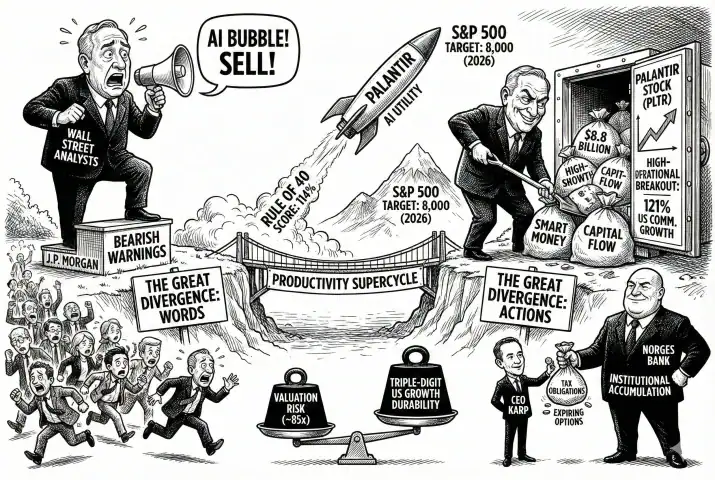
The late 2025 financial landscape is defined by a “Great Divergence” where major institutions issue bearish warnings about an AI bubble while simultaneously accumulating high-growth assets like Palantir to capture the upside of a productivity supercycle. Palantir has validated its premium valuation through a stunning 121% growth in U.S. commercial revenue, effectively transitioning from a government contractor to a critical enterprise AI utility. Investors are advised to prioritize capital flow data over headline rhetoric, as the “smart money” positions itself for an S&P 500 target of 8,000 by 2026, driven by inelastic demand for AI infrastructure.
Key Takeaways
- The Institutional Paradox: A stark contradiction exists between Wall Street’s words and actions; while JPMorgan’s analysts warn of an “AI Bubble,” its asset management arm holds over $8.8 billion in Palantir stock, reinforcing the “follow the money” thesis.
- Operational Breakout: Palantir’s Q3 2025 results obliterated the bear case, delivering 121% U.S. Commercial revenue growth and an unprecedented “Rule of 40” score of 114%, proving that its AIP Bootcamps are converting pilots to revenue at scale.
- Macro Tailwind to 8,000: Leading banks (Deutsche Bank, Morgan Stanley, JPMorgan) have raised their 2026 S&P 500 targets to between 7,500 and 8,000, betting that AI-driven productivity will sustain high corporate margins despite a “K-shaped” economic recovery.
- Insider Selling Context: While CEO Alex Karp’s ~$2 billion stock sale generated headlines, forensic analysis suggests this was largely driven by tax obligations and expiring options, and it was absorbed by net-positive institutional accumulation from sovereign wealth funds like Norges Bank.
- Valuation Risk: Trading at ~85x forward sales, Palantir is priced for perfection; the critical metric to watch in 2026 is not total revenue, but the specific durability of the triple-digit growth rate in the U.S. commercial sector.
1. Executive Thesis: The Great Divergence of 2025
As the global financial markets approach the conclusion of 2025, a profound dichotomy has emerged within the institutional investment landscape, characterized by a stark contrast between strategic rhetoric and capital allocation. This phenomenon, which may be termed the ‘Great Divergence,’ is most visibly engaged in the semiconductor and software sectors, specifically regarding the sustainability of the Artificial Intelligence (AI) investment cycle. On one hand, the research divisions of major global investment banks have issued increasingly strident warnings regarding the potential formation of an asset bubble, citing the widening disparity between capital expenditures (CapEx) on AI infrastructure and the realized revenue generation from AI applications. On the other hand, the asset management arms of these very same institutions have engaged in aggressive accumulation of high-beta AI equities, positioning portfolios to capture the upside of what they internally model as a multi-year supercycle.
Palantir Technologies (PLTR) stands as the singular corporate entity that most perfectly encapsulates this market tension. By November 2025, Palantir had transitioned from a specialized government contractor to a bellwether for commercial enterprise AI adoption, reporting financial metrics that defied conventional growth-at-scale logic.
However, beneath the headline metrics lies a complex tapestry of risk and reward. JPMorgan Chase & Co., a titan of global finance, exemplifies the institutional paradox. Its analysts warn that the tech industry requires an incremental $650 billion in revenue to justify current infrastructure spend.
(https://www.nasdaq.com/market-activity/stocks/pltr/institutional-holdings) This report aims to deconstruct this paradox through a rigorous forensic analysis of institutional positioning, macroeconomic forecasting, and corporate fundamental performance.
The analysis that follows posits that the current market environment is not merely a speculative mania, but a rational, albeit high-risk, pricing of a ‘winner-take-most’ industrial revolution. In this context, institutional capital flows suggest that asset managers have concluded that the risks of missing the AI platform shift outweigh the risks of short-term valuation compression.
2. Institutional Positioning and the Architecture of Modern Finance
To understand the conflicting signals emanating from Wall Street, one must first dissect the structural and regulatory architecture of the modern investment bank. The discrepancy between a bank’s ‘view’ (published research) and its ‘position’ (held assets) is not an error of consistency but a feature of regulatory design.
2.1 The ‘Chinese Wall’ and Structural Separation
This separation is designed to prevent material non-public information (MNPI) from influencing trading decisions and to ensure that research analysts are not pressured to issue favorable ratings to win investment banking business. In practice, this leads to a scenario where distinct autonomous units within the same parent holding company operate with divergent mandates and datasets.
Table 1: Functional Separation within Major Financial Institutions
| Operational Unit | Primary Mandate | Incentive Structure | Relationship to PLTR Stock |
|---|---|---|---|
| Equity Research (Sell-Side) | Provide objective market analysis and valuation models. | Reputation, accuracy of calls, client utility. | May issue ‘Underweight’ or ‘Neutral’ based on valuation concerns (e.g., P/E > 80x). |
| Asset Management (Buy-Side) | Generate alpha (excess returns) for fund investors. | Assets Under Management (AUM) growth, performance fees. | Accumulates shares based on momentum, growth, and portfolio composition requirements. |
| Investment Banking | Advise on M&A, IPOs, and capital raising. | Deal fees, transaction volume. | Restricted from trading; holds confidential strategic data. |
The asset managers are ‘buying the growth,’ while the analysts are ‘critiquing the valuation.’ These two actions are mutually exclusive in logic but simultaneous in execution.
2.2 Forensic Analysis of Q3 2025 Institutional Holdings
The 13F filings for the quarter ending September 30, 2025, provide a granular view of how the ‘Smart Money’ is positioning itself.
The data reveals a decisive shift toward high-conviction accumulation of Palantir stock, effectively treating it as a foundational utility of the AI economy rather than a speculative gamble.
JPMorgan Chase & Co.’s reported holding of 34,666,018 shares is a figure of immense significance. Valued at approximately $8.85 billion at late-2025 prices, this position represents a high-conviction bet. It is crucial to contextualize this against the holdings of other major custodians.
Table 2: Comparative Institutional Holdings (Q3 2025)
| Institution | Shares Held (Approx.) | Trend/Change | Strategic Implication |
|---|---|---|---|
| JPMorgan Chase & Co. | 34.6 Million | Accumulation | Validates PLTR as a core institutional holding despite high valuation. |
| Norges Bank | 24.3 Million | +34.9% Increase | Sovereign wealth endorsement; indicates long-term holding horizon. |
| FMR LLC (Fidelity) | 22.4 Million | +17.8% Increase | Active management buy-in; suggests belief in earnings durability. |
| Invesco Ltd. | 21.8 Million | +5.9% Increase | Momentum-based accumulation typically associated with QQQ/Tech funds. |
| Morgan Stanley | 30.2 Million | -8.2% Decrease | Profit-taking or rebalancing; contrasts with bullish research rhetoric. |
Norges Bank, as a sovereign wealth fund, typically operates with a multi-generational time horizon. Their substantial increase in allocation suggests a view that Palantir has crossed the chasm from ‘volatile tech stock’ to ‘strategic industrial asset.’ Conversely, Morgan Stanley’s reduction of 2.7 million shares (-8.2%) highlights the divergence of opinion even among the bullish elite, likely reflecting strict risk management protocols regarding position sizing after Palantir’s massive 2025 rally.
2.3 The Passive vs. Active Flow Dynamic
A critical driver of this institutional ownership is the ‘S&P 500 Inclusion Effect.’ While the immediate price impact of inclusion is often theorized to dissipate after 35 trading days, the long-term structural impact is permanent buying pressure from passive index funds (ETFs like SPY, VOO, IVV).
However, the data from Q3 2025—a full year after inclusion—shows that active managers are still the primary drivers of price discovery.
3. Macroeconomic Outlook: The 2026 Supercycle
To justify Palantir’s valuation of 85x forward sales, one must believe in a macroeconomic environment that supports extreme multiple expansion. The outlook for 2026 provided by major financial institutions offers exactly this backdrop: a ‘Goldilocks’ scenario of falling interest rates, resilient growth, and an AI-driven productivity boom.
3.1 The Race to S&P 500 8,000
As of late 2025, the consensus on Wall Street has shifted from ‘recession watch’ to ‘melt-up.’ This forecast is predicated on an Earnings Per Share (EPS) estimate of roughly $320 for the index.
The logic underpinning the 8,000 target is tripartite:
- AI Diffusion: The thesis that AI benefits will spill over from the ‘Hyperscalers’ (Phase 1) to the broader corporate economy (Phase 2), lifting margins across healthcare, finance, and industrials.
- Productivity Gains: A belief that AI-driven efficiency is not hype but a measurable deflationary force on labor costs, allowing profit margins to remain at historic highs despite wage inflation.
- Multiple Expansion: With the Federal Reserve expected to cut rates (or pause hiking), the discount rate applied to future cash flows decreases, mathematically justifying higher P/E ratios.
JPMorgan’s strategy team has echoed this sentiment, setting a base target of 7,500 with a ‘blue sky’ scenario exceeding 8,000 if the Fed eases policy aggressively. This alignment between two of the world’s largest banks creates a powerful ‘narrative gravity’ that pulls capital into the market.
Table 3: Wall Street Consensus Forecasts for Year-End 2026
| Institution | S&P 500 Target | Core Thesis Driver | Implied Market P/E (Approx.) |
|---|---|---|---|
| Deutsche Bank | 8,000 | AI diffusion drives EPS to $320; structural margin expansion. | ~25x |
| JPMorgan | 7,500 (Base) | US exceptionalism + AI Supercycle; ‘World’s Growth Engine.’ | ~23x |
| Morgan Stanley | 7,800 | ‘New Bull Market’; deregulation + corporate pricing power. | ~24x |
| HSBC | 7,500 | AI investment broadening beyond Big Tech. | ~23x |
3.2 High-Beta Sensitivity and the Wealth Effect
In a market targeting 8,000, high-beta assets like Palantir serve as the ‘tip of the spear.’ Beta measures a stock’s volatility relative to the market; Palantir historically exhibits a beta significantly greater than 1.0. If the S&P 500 rises 20% to reach 8,000, high-beta AI stocks are implicitly expected to rise 30-50% to lead that charge.
This macroeconomic environment creates a ‘permissive’ atmosphere for valuation. When the broad market trades at 23-25x earnings, investors are psychologically conditioned to accept 80x or 100x multiples for companies growing at 60% per year. The ‘wealth effect’ of rising portfolio values encourages risk-taking, funneling capital away from defensive sectors (utilities, staples) and into secular growth themes (software, defense tech).
3.3 The Risk of ‘Circular’ Economics
However, the ‘AI Bubble’ concerns raised by JPMorgan’s research team provide a necessary counterweight to this optimism.(https://m.economictimes.com/news/international/us/jpmorgan-warns-ai-boom-needs-650-billion-a-year-just-for-10-return-bubble-brewing/articleshow/125280375.cms)
The risk is that the 2026 targets rely on earnings growth that may not materialize if corporate AI adoption stalls.(https://am.jpmorgan.com/hk/en/asset-management/adv/insights/market-insights/market-updates/on-the-minds-of-investors/do-circular-ai-deals-warn-of-a-bubble/) If this unwinds, as the telecom vendor financing schemes did in 2000-2001, the reversion would be severe. Palantir, however, argues it is immune to this specific risk because its revenue comes from external, non-circular sources: the U.S. Government and established Fortune 500 entities (e.g., Lowe’s, BP, Airbus).
4. Palantir Technologies: Operational Forensics of the 2025 Breakout
The bridge between the macroeconomic ‘Supercycle’ and Palantir’s specific stock performance is the company’s operational execution. The Q3 2025 financial results serve as the primary evidence that Palantir has successfully crossed the ‘Valley of Death’ from niche consultancy to scalable software platform.
4.1 The Explosion of U.S. Commercial Revenue
(https://investors.palantir.com/news-details/2025/Palantir-Reports-Q3-2025-U-S–Comm-Revenue-Growth-of-121-YY-and-Revenue-Growth-of-63-YY-Guides-Q4-Revenue-to-61-YY-and-U-S–Comm-Revenue-to-121-YY-Raises-FY-2025-Revenue-Guidance-to-53-YY-Crushing-Consensus-Expectations/) This metric is the ‘North Star’ for institutional investors because it proves that the Artificial Intelligence Platform (AIP) is achieving product-market fit at an accelerating rate.
Historically, Palantir was viewed as a slow-moving government contractor with a ‘black box’ commercial business. The 121% growth rate shatters this perception. It implies that the ‘Bootcamp’ sales strategy—where Palantir engineers deploy usable AI workflows for customers in 1-5 days at no upfront cost—is converting pilots to paid contracts with high efficiency.
Table 4: Palantir Q3 2025 Financial Performance Matrix
| Metric | Q3 2025 Result | YoY Growth | Strategic Significance |
|---|---|---|---|
| Total Revenue | $1.181 Billion | +63% | Acceleration from ~30% in 2024; hypergrowth status restored. |
| US Commercial Rev | $397 Million | +121% | Validates AIP adoption; diversifies away from gov’t dependency. |
| US Government Rev | $486 Million | +52% | Strong re-acceleration driven by geopolitical instability. |
| GAAP Net Income | $476 Million | N/A (40% Margin) | exceptional profitability; eliminates ‘cash burn’ bear thesis. |
| Rule of 40 Score | 114% | N/A | elite efficiency; 40% represents excellence, 114% is an outlier. |
| Cash Reserves | $6.4 Billion | N/A | Fortress balance sheet; enables M&A or buybacks. |
4.2 The Rule of 40: Redefining Efficiency
In the software-as-a-service (SaaS) industry, the ‘Rule of 40’ is the gold standard for measuring the balance between growth and profitability. It is calculated by adding the revenue growth rate (%) to the profit margin (%). A combined score of 40% or higher is considered excellent.
(https://www.investing.com/news/company-news/palantir-q3-2025-slides-us-commercial-revenue-soars-121-rule-of-40-hits-114-93CH-4328928) This is mathematically derived from its 63% revenue growth plus a 51% adjusted operating margin. Such a score is virtually unprecedented for a company of Palantir’s scale (>$4 billion annual revenue run-rate). It suggests that the company has extreme operating leverage: the cost to add the next dollar of revenue is significantly lower than the revenue itself. This leverage is likely driven by the mature ‘Foundry’ and ‘Gotham’ codebases requiring less incremental R&D per new deployment, and the AIP ‘Bootcamps’ compressing sales cycles from months to days.
4.3 Government Re-Acceleration and Geopolitics
While the commercial business captures the ‘AI’ premium, the government business provides the ‘Defense’ floor.(https://investors.palantir.com/news-details/2025/Palantir-Reports-Q3-2025-U-S–Comm-Revenue-Growth-of-121-YY-and-Revenue-Growth-of-63-YY-Guides-Q4-Revenue-to-61-YY-and-U-S–Comm-Revenue-to-121-YY-Raises-FY-2025-Revenue-Guidance-to-53-YY-Crushing-Consensus-Expectations/)
This re-acceleration is inextricably linked to the geopolitical environment. The conflicts in Eastern Europe and the Middle East have necessitated real-time logistics and intelligence capabilities that legacy defense contractors (Primes) struggle to provide. Palantir’s ‘Maven Smart System,’ deployed with NATO and U.S. forces, has become the operating system for modern warfare. The ‘stickiness’ of these contracts is absolute; once a military integrates its sensor networks and decision chains into an ontology, switching costs become prohibitive. This provides a 10-20 year revenue tailwind that is largely uncorrelated with the commercial business cycle.
5. The Competitive Landscape: Ontology vs. The Lakehouse
A comprehensive analysis must address the competitive threat, primarily posed by private-market giant Databricks. As of late 2025, Databricks is reportedly seeking a valuation of $130 billion ahead of a 2026 IPO.
5.1 The Technical Divergence
The competition between Palantir and Databricks is often misunderstood as a direct head-to-head clash. In reality, it is a battle between two different layers of the enterprise stack:
- Databricks (The Lakehouse): Focuses on the storage and processing layer. It unifies data warehouses and data lakes, allowing data scientists to run models on raw data. It is ‘bottom-up,’ catering to technical engineers.
- Palantir (The Ontology): Focuses on the operational layer. It sits on top of the data lake (including Databricks), mapping data to real-world objects (e.g., a ‘factory,’ a ‘tank,’ a ‘customer’). It is ‘top-down,’ catering to decision-makers and operators.
However, the lines are blurring. Databricks is moving ‘up-stack’ with its ‘MosaicML’ acquisition to offer generative AI tools, while Palantir is moving ‘down-stack’ with its ‘Compute Module.'(https://stocktwits.com/news-articles/markets/equity/palantir-rival-databricks-reportedly-chases-130-b-valuation-in-new-funding-round/cLPNtEAREeA) If Databricks successfully builds a ‘good enough’ application layer, it could commoditize Palantir’s offering.
5.2 The ‘Messi vs. Mbappe’ Analogy
Analysts have utilized the ‘Messi vs. Mbappe’ analogy to describe this dynamic. Palantir (Messi) is the established virtuoso with a unique, perhaps unreplicable capability (the Ontology) that solves the hardest problems. Databricks (Mbappe) is the high-velocity, mass-market powerhouse that wins on volume and ubiquity.
- Strategic Implication: The partnership announced between the two firms, allowing Palantir to read data directly from Databricks Delta Lake, suggests a ‘co-opetition’ model. Palantir effectively admits it won’t win the storage war, and Databricks admits it needs Palantir’s interface to make data useful for non-coders.
5.3 Cost Deflation in Compute
A significant tailwind for both companies—and specifically for Palantir’s margins—is the deflation in GPU compute costs. After the shortages of 2023-2024, the rental price for an Nvidia H100 GPU has stabilized around $2.85 – $3.50 per hour in late 2025. This reduction in input costs allows Palantir to run its AIP bootcamps and host customer models with higher gross margins. It also lowers the barrier to entry for customers, increasing the Total Addressable Market (TAM) for AI adoption.
6. Valuation Dynamics and Market Mechanics
By November 2025, Palantir had earned the dubious distinction of being the ‘most expensive stock in the S&P 500,’ trading at approximately 85 times expected forward sales. This valuation creates a binary risk profile: the stock is priced for perfection, and any deviation from the hyper-growth trajectory could result in a severe correction.
6.1 Understanding the Premium
Why does the market assign an 85x multiple to Palantir when the S&P 500 average is ~23x?
- Scarcity of Pure-Play AI: There are very few publicly traded companies that are ‘pure plays’ on Enterprise AI software. Microsoft and Google are diluted by legacy businesses; Nvidia is hardware. Palantir is the primary vehicle for investors seeking exposure to the application layer of AI.
- The ‘Rule of 40’ Premium: Investors pay up for efficiency. A company with a 114% Rule of 40 score commands a significantly higher multiple than one with a 40% score.
- Governance Discount Reversal: Historically, Palantir traded at a discount due to its triple-class share structure (giving founders control). The market has now inverted this, viewing the founder control as a ‘visionary premium’ that protects the company from short-termism.
6.2 The Short Squeeze and Capitulation
The market mechanics of late 2025 have been defined by the capitulation of short sellers.(https://www.s3partners.com/articles/palantir-pltr-posts-a-40-percent-week-elevating-squeeze-scores-and-exposing-short-vulnerabilities)(https://www.s3partners.com/articles/palantir-pltr-posts-a-40-percent-week-elevating-squeeze-scores-and-exposing-short-vulnerabilities(https://www.s3partners.com/articles/palantir-pltr-posts-a-40-percent-week-elevating-squeeze-scores-and-exposing-short-vulnerabilities))
This creates a self-reinforcing loop (reflexivity):
- Stock rises on strong earnings.
- Shorts are forced to cover (buy stock), driving price higher.
- The higher price attracts momentum algorithms and retail flows.
- The valuation expands further, detaching from fundamentals.
(https://www.sahmcapital.com/news/content/looking-into-palantir-technologies-incs-recent-short-interest-2025-10-31) Future gains must be driven by genuine long-term accumulation, not short covering.
7. Governance, Insider Selling, and Structural Risks
No analysis of Palantir is comprehensive without addressing the Elephant in the Room: the massive insider liquidation events of 2024 and 2025.
7.1 The $2 Billion Sell-Off
CEO Alex Karp and other insiders have sold approximately $2 billion in stock over the 2024-2025 period. In November 2025 alone, Karp sold nearly $400 million in shares. While these sales are executed under Rule 10b5-1 plans—which are pre-scheduled legal instruments designed to prevent accusations of insider trading—the magnitude is staggering.
Table 5: Insider Trading Activity (2024-2025)
| Executive | Approx. Value Sold | Strategic Implication |
|---|---|---|
| Alex Karp (CEO) | ~$2.0 Billion | Massive liquidity event; raises questions about alignment. |
| Shyam Sankar (CTO) | ~$410 Million | Significant diversification; notable for a technical founder. |
| David Glazer (CFO) | ~$56 Million | Routine diversification relative to total holdings. |
The signaling effect of this selling is debated. The bearish view is that management believes the stock is overvalued and is ‘cashing out’ at the top. The bullish counter-argument is that Karp has held these options for nearly two decades (since founding in 2003) and they are expiring; he must exercise and sell to cover the massive tax bill (often 50%+) associated with the exercise. The truth likely lies in the middle: it is a tax-driven necessity that conveniently aligns with a historic valuation peak.
7.2 Stock-Based Compensation (SBC) Dilution
(https://www.macrotrends.net/stocks/charts/PLTR/palantir-technologies/stock-based-compensation) While Palantir has reduced SBC as a percentage of revenue compared to 2020, it remains a massive absolute cost.
For shareholders, SBC is a hidden inflation. It increases the share count, diluting the ownership stake of existing holders. When calculating true valuation, sophisticated investors look at ‘Fully Diluted’ shares. The fact that Palantir is now GAAP profitable despite this massive SBC charge is a testament to the strength of its gross margins, but the dilution remains a long-term drag on EPS growth.
8. Geopolitics and Regulation: The EU AI Act
Finally, the regulatory landscape in 2025 presents both a threat and an opportunity. The European Union’s AI Act has fully entered into force, establishing the world’s first comprehensive legal framework for AI.
8.1 Compliance as a Moat
The AI Act categorizes AI systems by risk (Unacceptable, High, Limited, Minimal). ‘High-Risk’ systems (e.g., critical infrastructure, employment, law enforcement) face stringent requirements for data governance, transparency, and human oversight.
This regulation, often viewed as a hindrance to innovation, may paradoxically benefit Palantir.
- The Compliance Advantage: Palantir’s software was born in the highly regulated, classified environments of the CIA and DoD. It has native capabilities for ‘Access Control Lists’ (ACLs), data lineage tracking, and audit logs that most commercial AI startups lack.
- The ‘Safe Harbor’ Effect: European enterprises, terrified of the fines (up to 7% of global turnover), may flock to Palantir as a ‘safe’ vendor that guarantees compliance out of the box. Palantir has actively engaged with EU policymakers and positioned AIP as a compliance engine.
8.2 Reputational Friction
(https://www.business-humanrights.org/es/%C3%BAltimas-noticias/palantir-allegedly-enables-israels-ai-targeting-amid-israels-war-in-gaza-raising-concerns-over-war-crimes/) While this does not impact its U.S. government revenue, it can create friction in winning contracts with more ‘progressive’ European governments or consumer-facing brands concerned about ESG (Environmental, Social, and Governance) scores. The company’s unapologetic stance on supporting Western allies is a double-edged sword: it solidifies its core defense base while potentially alienating a segment of the commercial market.
9. Conclusion: The Strategic Outlook
As we look toward 2026, the data presents a picture of a company operating at peak execution within a market operating at peak optimism.
- The Institutional Verdict: The ‘Smart Money’ has spoken. Despite the warnings of their own research departments, asset managers at JPMorgan, Fidelity, and Norges Bank have accumulated massive positions in Palantir. They have concluded that the AI platform shift is the dominant theme of the decade and that Palantir is one of the few pure-play winners.
- The Valuation Reality: Trading at 85x sales is a precarious position. It demands not just continued growth, but accelerating growth. The 121% US commercial expansion in Q3 2025 provides the necessary fuel to sustain this multiple for now, but any stumble will be punished severely.
- The Macro Tailwind: If the S&P 500 pushes toward the 8,000 targets set by Deutsche Bank and JPMorgan, the liquidity tide will likely keep high-beta boats like Palantir afloat, potentially driving the stock into a climactic ‘melt-up’ phase.
For the investor, the path forward requires navigating the tension between the ‘Great Divergence’ of institutional rhetoric and reality. The metrics suggest that the ‘AI Bubble’ is not a hollow sphere of hype, but a reinforced structure built on tangible revenue acceleration—at least for Palantir. However, the $2 billion in insider selling stands as a stark reminder that even the architects of this revolution are happy to take chips off the table when the market offers a historic premium.
Final Recommendation for Observation: The key metric to watch in Q1 and Q2 2026 is not total revenue, but the deceleration of US Commercial growth. If that 121% figure drops rapidly to 40% or 50%, the valuation multiple will collapse. If it sustains above 80%, the path to S&P inclusion and beyond remains open.
Leave a Reply