
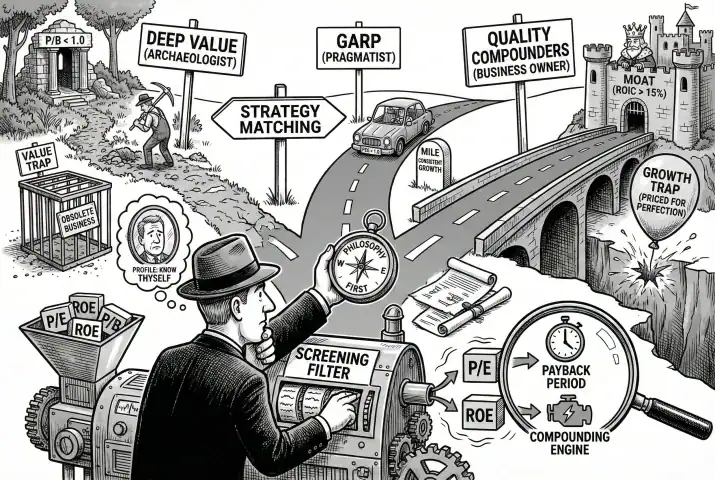
Summary
- Philosophy First: Effective stock screening is not just about filtering numbers; it is the mathematical application of a specific investment philosophy (such as Value, Growth, or Quality) that must align with the investor’s psychological profile.
- Context is King: Financial metrics like P/E and ROE should not be viewed in isolation but understood through practical analogies (e.g., “payback period” or “compound interest”) to avoid pitfalls like “Value Traps” or overpriced hype.
- Strategy Matching: Investors must choose a strategy—whether it be Deep Value (buying distressed assets), GARP (buying growth at a fair price), or Quality (buying competitive moats)—that fits their risk tolerance and ability to handle market volatility.
Key Takeaways
1. The Logic of Metrics (The “Why”)
- P/E Ratio (The Payback Period): A P/E of 15 implies it takes 15 years for the company to earn back your investment. Low P/E is good, but if it’s too low, the company might be dying (a Value Trap).
- ROE (The Engine): Return on Equity measures how efficiently a company compounds capital. High ROE is essential for long-term growth, provided it isn’t fueled solely by excessive debt.
- P/B Ratio (The Safety Net): Represents the liquidation value of hard assets. Crucial for Deep Value investing but often irrelevant for asset-light tech companies.
2. Strategic Frameworks
- Deep Value (The Archaeologist):
- Goal: Buy dollar bills for 50 cents.
- Key Screen: Low P/B (< 1.0) + High Piotroski F-Score (financial health) to ensure the company is turning around, not going bankrupt.
- GARP (The Pragmatist):
- Goal: Buy fast-growing companies without overpaying.
- Key Screen: PEG Ratio < 1.0 (P/E is lower than the Growth Rate) and consistent earnings growth.
- Quality Compounders (The Business Owner):
- Goal: Own superior business models forever.
- Key Screen: High ROIC (> 15%) and High Gross Margins (> 40%) to identify companies with “Moats” (pricing power), ignoring P/B.
3. Psychological Discipline
- Know Thyself: The success of a screener depends on the investor’s behavior. Deep Value investors must withstand the social pain of buying unpopular stocks, while Momentum investors must have the discipline to cut losses quickly.
- Avoid the Traps:
- Value Trap: A stock that is cheap because its business is obsolete (screened out by checking Debt and Cash Flow).
- Growth Trap: A stock priced for perfection that crashes when growth slows (screened out by PEG limits)
1. Introduction: The Epistemology of the Stock Screener
In the contemporary financial landscape, the individual investor possesses computational power that would have been the envy of institutional trading desks a mere three decades ago. The ability to filter the entire global equity universe based on granular financial metrics in milliseconds is a technological marvel. However, this accessibility presents a paradoxical challenge: the abundance of data often obfuscates the clarity of decision-making. A standard stock screener, utilized without a profound understanding of the underlying financial philosophy, is merely a blunt instrument. To set a filter for a Price-to-Earnings (P/E) ratio of less than 15 and a Return on Equity (ROE) of greater than 10% is to perform a rudimentary sort, a digital equivalent of separating fruit by size without regard for ripeness or variety.
True quantitative screening is not simply a search function; it is the mathematical expression of an investment philosophy. Every metric selected, every threshold applied, and every exclusion criterion established serves as a proxy for a specific worldview regarding how economic value is generated, preserved, and recognized by the market. When an investor selects a low Price-to-Book (P/B) ratio, they are implicitly accepting the tenets of mean reversion and asset protection. When they filter for high Earnings Growth, they are subscribing to the momentum of innovation and market share expansion. Thus, the screener is the bridge between abstract financial theory and the tangible construction of a portfolio.
This report aims to deconstruct that bridge and rebuild it with greater sophistication. We will move beyond the elementary Value 101 screens to explore advanced combinations of metrics that isolate specific characteristics of corporate performance. Furthermore, we will dissect the metrics themselves, moving beyond textbook definitions to explore their nuance and their real-world implications. For the uninitiated, we will deploy rich, beginner-friendly analogies to demystify these concepts.
2. Foundational Metrics: The Anatomy of Financial Performance
Before constructing complex screening architectures, it is imperative to establish a nuanced, first-principles understanding of the fundamental building blocks. Financial ratios are dynamic indicators of a company’s relationship with the market, its capital structure, and its operational efficiency.
2.1 The Price-to-Earnings (P/E) Ratio: The Theoretical Payback Period
The Academic Definition
The Price-to-Earnings ratio is the most ubiquitous metric in finance. It is calculated by dividing the current market price per share by the Earnings Per Share (EPS). It represents the multiple of current earnings investors are willing to pay to own a slice of the company’s equity Analysis of P/E ratio reliability and usage.
The Beginner’s Analogy: The Money Printing Machine
Imagine you are offered the opportunity to purchase a machine that prints money. This machine is guaranteed to print $100 bills, one after another, totaling $100 per year. The seller asks you to pay $1,500 for this machine.
In this scenario:
- The Price (P): $1,500
- The Earnings (E): $100 per year
- The P/E Ratio: 15 ($1,500 / $100)
What does the number 15 tell you? It tells you the payback period. Assuming the machine never breaks down and never speeds up, it will take exactly 15 years for the machine to pay for itself through its own production. If the seller asked for $3,000, the P/E would be 30, implying a 30-year payback period(https://fastgraphs.com/blog/why-a-15-p-e-ratio-is-fair-value-for-most-companies/).
Nuanced Insight and Evidence-Based Logic
While the ‘payback period’ analogy is useful, it is imperfect because it assumes zero growth. In the real market, a P/E of 30 is not necessarily ‘expensive,’ nor is a P/E of 5 necessarily ‘cheap.’
- The Growth Factor: If the money machine increases its output by 20% every year, a P/E of 30 might actually be cheap because the payback period will accelerate rapidly.
- The Value Trap: Conversely, if the machine is rusting and will print 10% less every year, a P/E of 5 might be expensive because it may break down before you recoup your investment.
2.2 Return on Equity (ROE): The Internal Compounding Engine
The Academic Definition
Return on Equity measures the profitability of a corporation in relation to stockholders’ equity. It answers the question: For every dollar of capital the shareholders have left in the business, how much profit does management generate?(https://www.investopedia.com/ask/answers/010915/does-high-price-book-ratio-correspond-high-roe.asp)
The Beginner’s Analogy: The Savings Account
Consider two savings accounts at two different banks.
- Bank A (Company A): You deposit $100. At the end of the year, the bank pays you $5 in interest. Your return is 5%.
- Bank B (Company B): You deposit $100. At the end of the year, the bank pays you $20 in interest. Your return is 20%.
Clearly, Bank B is the superior vehicle for your capital. In the corporate world, ROE is that interest rate. If a company has an ROE of 20%, it is effectively turning its internal capital into profit at a rate of 20% per year.
Nuanced Insight
High ROE is desirable, but it can be engineered through debt. Since Shareholder Equity equals Assets minus Liabilities, if a company takes on massive debt, the Equity shrinks. If Net Income remains stable, the ROE mathematically shoots up. Therefore, smart screening pairs ROE with Debt-to-Equity ratios to ensure the returns are driven by business excellence, not risky borrowing(https://www.investopedia.com/terms/r/returnoninvestmentcapital.asp).
2.3 Price-to-Book (P/B) Ratio: The Liquidation Value
The Academic Definition
The P/B ratio compares the market’s valuation of the company to the value of its net assets (Book Value). It is often used as a measure of tangible safety(https://www.investopedia.com/terms/p/price-to-bookratio.asp).
The Beginner’s Analogy: The Used Car Dealership
Imagine buying a used car dealership.
- Book Value: The sum of the value of the cars on the lot, the building, and the cash in the register, minus the debts owed to the bank. If you liquidated the business today, this is what you would have.
- Market Price: The price the owner wants you to pay to take over the business.
If the dealership has $1 million in assets and the owner sells it to you for $800,000, the P/B ratio is 0.8. You are buying a dollar of assets for 80 cents. This provides a ‘Margin of Safety.’ If the business fails, you can theoretically sell the assets and make your money back.
2.4 Beta: The Measure of Volatility
The Academic Definition
Beta measures the systematic risk of a security relative to the broader market. A Beta of 1.0 implies the stock moves in lockstep with the market. A Beta greater than 1.0 implies higher volatility(https://www.investopedia.com/terms/b/beta.asp).
The Beginner’s Analogy: The Dog Walker
Imagine a person walking a dog on a leash. The person represents the Market, and the dog represents the Stock.
- Beta = 1.0: The dog walks perfectly alongside the owner. If the owner takes a step right, the dog takes a step right.
- Beta = 2.0 (High Beta): This is a hyperactive puppy on a bungee cord. If the owner walks 1 mile, the puppy runs 2 miles zig-zagging back and forth. It is exciting but risky; the puppy might run into traffic (big losses) or find a treat (big gains).
- Beta = 0.5 (Low Beta): This is an old, lethargic basset hound. If the owner runs, the dog just walks faster. It resists movement. It will not get you there fast, but it won’t run off a cliff(https://www.northwesternmutual.com/life-and-money/what-is-beta/).
2.5 Enterprise Value to Free Cash Flow (EV/FCF): The Landlord’s Yield
The Academic Definition
This ratio compares the total valuation of the company (Enterprise Value) to the Free Cash Flow (operating cash less capital expenditures).
The Beginner’s Analogy: Cash in Pocket
P/E ratios can be tricked by accounting rules. Free Cash Flow (FCF) is the truth. Think of buying an apartment building.
- Net Income: This might include the appreciation of the building. You cannot spend appreciation at the grocery store.
- Free Cash Flow: This is the rent checks collected, minus the cost of fixing the roof. It is the cold, hard cash that lands in your pocket. EV/FCF asks: ‘If I bought this entire building, how much cash yield would I get in my pocket each year?'(https://www.investopedia.com/articles/fundamental-analysis/09/free-cash-flow-yield.asp)
3. Strategy Profile A: Deep Value / ‘The Turnaround’
Philosophy and User Profile
Deep Value investing is the financial equivalent of archaeology. It involves digging through the rubble of the market to find artifacts that have been discarded by others but retain intrinsic value.
- Target User: ‘The Asset Manager.’ You must be thick-skinned, patient, and contrarian. You are comfortable buying stocks that are in the news for the wrong reasons, trusting in the tangible assets on the balance sheet.
- Psychological Pain Point: Social Isolation. Everyone else is buying tech stocks while you are buying a boring steel manufacturer.
Advanced Screener Combination: The Graham-Piotroski Hybrid
This screen merges Benjamin Graham’s safety concepts with Joseph Piotroski’s F-Score to filter out companies that are cheap because they are actually dying (Value Traps)(https://www.quant-investing.com/blog/how-to-master-deep-value-investing).
| Metric | Threshold | Logic & Evidence |
|---|---|---|
| Price-to-Book (P/B) | < 1.0 | The Anchor: You are paying less than the accounting value of the net assets. Historically, the lowest decile of P/B stocks outperforms over long horizons(https://www.investopedia.com/articles/fundamental-analysis/09/five-must-have-metrics-value-investors.asp). |
| Piotroski F-Score | >= 7 | The Filter: The F-Score acts as a quality control mechanism. It awards points for improving margins, asset turnover, and liquidity. A high score indicates the company is fixing its operations despite the low stock price(https://www.investopedia.com/terms/p/piotroski-score.asp). |
| Debt-to-Equity | < 0.5 | The Safety Net: Turnarounds take time. Low debt ensures the company won’t go bankrupt while you wait for the market to realize its value(https://www.investopedia.com/terms/d/debtequityratio.asp). |
| Current Ratio | > 1.5 | Liquidity: Ensures the company has enough cash/assets to cover its bills for the next 12 months. |
Evidence of Success/Failure:
General Electric (GE) in 2017 serves as a cautionary tale for screening without quality filters. GE looked ‘cheap’ by some metrics, but its cash flows were deteriorating, and it had high debt. A simple Low P/E screen might have caught it, but a Piotroski filter (which penalizes falling margins and cash flow) would likely have flagged the risk before the dividend cut and subsequent crash(https://www.investopedia.com/news/ge-dividends-slashed-over-90/).
4. Strategy Profile B: Growth at a Reasonable Price (GARP)
Philosophy and User Profile
GARP is the ‘Golden Mean’ of investing, popularized by Peter Lynch. It rejects the austerity of Deep Value and the recklessness of pure Momentum.
- Target User: ‘The Pragmatist.’ You want to own winning companies but refuse to overpay. You are willing to wait for a market correction to buy your favorite stock.
- Psychological Pain Point: Missing Out. You often sit on the sidelines when a hype stock doubles, knowing its valuation is irrational.
Advanced Screener Combination: The PEG-Efficiency Model
| Metric | Threshold | Logic & Evidence |
|---|---|---|
| PEG Ratio | 0.5 < PEG < 1.0 | The Arbitrage: The P/E ratio is lower than the growth rate. A PEG < 1.0 historically implies undervaluation relative to growth speed(https://corporatefinanceinstitute.com/resources/valuation/peg-ratio-overview/). |
| EPS Growth (3yr) | > 15% | Consistency: Ensures the growth is a trend, not a one-time event. |
| Return on Equity | > 15% | Efficiency: Confirms that growth is being generated efficiently. A company growing EPS just by borrowing money (low ROE) is dangerous; a company growing via high ROE is sustainable(https://www.investopedia.com/ask/answers/010915/does-high-price-book-ratio-correspond-high-roe.asp). |
| FCF / Net Income | > 0.8 | Quality Check: If a company reports $100 in Net Income but has $0 in Free Cash Flow, the earnings may be accounting fiction. This ratio verifies the profit is real cash. |
Beginner Explanation of PEG:
If a P/E of 20 seems expensive, but the company is growing at 20% per year, the PEG is 1.0 (20 / 20). This is considered ‘Fair.’ If the P/E is 10 and growth is 20%, the PEG is 0.5. This is like buying a Ferrari for the price of a Toyota because the seller doesn’t realize how fast it can go.
5. Strategy Profile C: High-Quality Compounders / ‘The Moat’
Philosophy and User Profile
This strategy aligns with the modern Warren Buffett approach: ‘It is far better to buy a wonderful company at a fair price than a fair company at a wonderful price.’
- Target User: ‘The Business Owner.’ You are less concerned with stock price volatility and more concerned with the durability of the business’s competitive advantage. You plan to hold for 10+ years.
- Psychological Pain Point: Boredom. These stocks often chug along steadily while speculative junk stocks skyrocket in bubbles.
Advanced Screener Combination: The Capital Efficiency Screen
This strategy ignores P/B ratio, as high-quality companies often have few tangible assets (like software companies).
| Metric | Threshold | Logic & Evidence |
|---|---|---|
| ROIC | > 20% | The Moat Indicator: Return on Invested Capital measures how well a company uses debt and equity to generate return. A consistent ROIC > 20% is rare and usually indicates a monopoly-like advantage(https://www.morganstanley.com/im/publication/insights/articles/article_returnoninvestedcapital.pdf). |
| Gross Margin | > 40% | Pricing Power: High gross margins mean the company sells a unique product and can raise prices without losing customers Gross Profitability as a quality filter. |
| Debt / EBITDA | < 2.0 | Fragility Check: High quality means low reliance on bankers. The company should fund its own growth through internal cash flow. |
| Beta | 0.7 – 1.1 | Stability: We prefer companies that are less volatile than the market. |
6. Strategy Profile D: Dividend / Yield Defender
Philosophy and User Profile
This strategy views stocks as ‘Equity Bonds.’ The goal is income safety, with capital appreciation as a bonus.
- Target User: ‘The Retiree’ or ‘Income Architect.’ You need cash flow to pay bills and cannot afford a 50% drawdown in your portfolio.
Advanced Screener Combination: The Yield Gap Model
| Metric | Threshold | Logic & Evidence |
|---|---|---|
| FCF Yield | > 10Y Treasury + 3% | The Risk Premium: If the 10Y Treasury pays 4%, we demand stocks pay at least 7% in FCF yield to compensate for the risk of owning equity(https://www.investopedia.com/articles/fundamental-analysis/09/free-cash-flow-yield.asp). |
| Dividend Yield | > 3% | Income: Provides a tangible return while waiting for capital appreciation. |
| Payout Ratio | < 60% | Sustainability: Ensures the dividend is safe. If a company pays out 100% of earnings, a small drop in profit will force a dividend cut, crushing the stock price. |
| Interest Coverage | > 5.0 | Solvency: Ensures the company can easily pay its debt interest payments. |
Evidence:
General Electric in 2017 had a payout ratio that crept higher as cash flows fell, eventually leading to a dividend cut that decimated the stock price. A screener capped at a 60% payout ratio would have excluded GE before the crash(https://www.nasdaq.com/articles/general-electric-slashes-dividend-half-3-reasons-its-not-all-bad-news-2017-11-13).
7. Strategy Profile E: Momentum / ‘The Trend Follower’
Philosophy and User Profile
Momentum investors believe that ‘objects in motion stay in motion.’ They buy what is already going up.
- Target User: ‘The Surfer.’ You don’t care about the composition of the water (fundamentals); you care about the shape of the wave (price action). You must be disciplined to cut losses quickly.
Advanced Screener Combination: The Trend Template
Based on strategies like Mark Minervini’s trend template.
| Metric | Threshold | Logic & Evidence |
|---|---|---|
| Price vs SMA | Price > 200 SMA | Uptrend: The stock is in a long-term uptrend. Never short a stock above its 200-day moving average; never buy one below it(https://deepvue.com/screener/minervini-trend-template/). |
| Relative Strength | Top 20% (80+) | Outperformance: The stock must be outperforming 80% of other stocks over the last year. Winners tend to keep winning(https://www.investopedia.com/terms/r/rsi.asp). |
| EPS Growth (Qtr) | > 20% YoY | The Catalyst: Earnings are accelerating NOW. We don’t care about 5 years ago; we care about the current quarter’s explosion in profit. |
Cautionary Tale:
Momentum strategies fail spectacularly when the trend breaks (e.g., the Nifty Fifty crash or the Dot Com bubble). Cisco Systems had massive momentum in 2000 but crashed 80% when the trend reversed. Momentum requires strict ‘Stop Loss’ rules Cisco 2000 Crash Analysis.
8. Conclusion: Choosing Your Map
The metrics P/E, P/B, and ROE are not just numbers; they are coordinates on a map.
- If you want to find buried treasure in the mud, use the Deep Value coordinates (Low P/B, High F-Score).
- If you want to buy a high-speed train ticket at a discount, use the GARP coordinates (PEG < 1).
- If you want to own the railroad itself, use the Quality coordinates (High ROIC, High Margin).
The ‘best’ screener is not the one that returns the most stocks, but the one that aligns with your psychological ability to hold those stocks when the market gets rough.
Leave a Reply