
Summary
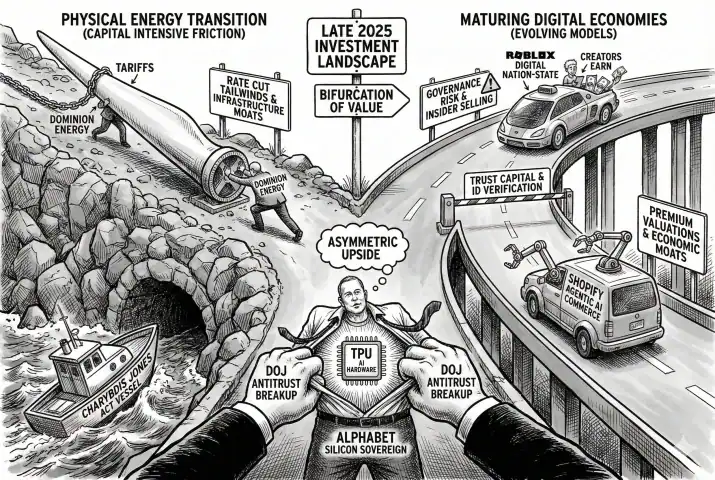
- The late 2025 investment landscape is defined by a “bifurcation of value,” where investors must distinguish between the capital-intensive friction of the physical energy transition and the maturing economic models of the digital world.
- High-growth digital platforms like Roblox and Shopify are evolving into professional labor markets and agentic AI economies, respectively, justifying premium valuations through deep economic moats despite governance and profitability concerns.
- Value opportunities lie in Dominion Energy, which balances tariff headwinds with interest rate tailwinds and infrastructure monopolies, and Alphabet, where the potential breakup value and AI hardware advancements offer asymmetric upside against antitrust risks.
Key Content Summary
1. Roblox (RBLX): The Digital Nation-State
- Maturation of Labor: Roblox has evolved from a game into a gig-economy labor market, paying out over $1 billion to creators in a single year, with top developers earning C-suite level incomes.
- Trust as a Moat: The company is strategically introducing friction (ID verification, 17+ age gating) to improve safety and attract older users/advertisers, effectively trading viral speed for higher “trust capital.”
- Financial Disconnect: While bookings and user growth are strong (70% YoY), the company continues to post significant net losses due to heavy spending on safety infrastructure.
- Insider Signal: CEO David Baszucki’s significant stock sales in late 2025 serve as a caution signal regarding the stock’s current premium valuation.
2. Dominion Energy (D): The Green Paradox
- Infrastructure Friction: The massive Coastal Virginia Offshore Wind (CVOW) project faces cost escalations due to protectionist tariffs, highlighting the conflict between green energy goals and trade policy.
- Strategic Asset: The ownership of the Charybdis—the first Jones Act-compliant wind installation vessel—creates a lucrative moat, as competitors must charter it for their own projects.
- Macro Tailwind: As a “bond proxy,” Dominion stands to benefit significantly from the Federal Reserve’s rate-cutting cycle, which lowers debt service costs and makes its ~4.8% dividend yield more attractive.
3. Shopify (SHOP): Agentic Commerce
- Service as Software: Shopify is pivoting to “Agentic AI,” where AI tools actively drive traffic and sales rather than just hosting storefronts, justifying a higher “take rate” of merchant revenue.
- Synchronized Growth: Unlike previous periods of divergence, GMV and Revenue are growing in lockstep (32%), proving the organic health of the ecosystem.
- Valuation Premium: Trading at over 80x forward earnings, Shopify is priced for perfection compared to Amazon (~28x), leaving zero margin for error.
- governance Risk: The company operates in “Founder Mode” with CEO Tobi Lütke holding absolute voting control, creating “Key Man Risk.”
4. Alphabet (GOOGL): The Silicon Sovereign
- Hardware Insurgency: Google is challenging Nvidia’s monopoly with its TPU (Tensor Processing Unit) chips, with reports of major clients like Meta potentially adopting them, which would be a massive revenue catalyst.
- Antitrust Paradox: While the DOJ seeks to break up Google (Ad Tech/Search/Chrome), an economist’s view suggests a breakup could unlock value. Standalone units like Waymo and Google Cloud are currently undervalued within the conglomerate structure.
- Asymmetric Risk: The market is pricing in the worst-case legal scenario, ignoring the best-case AI hardware scenario.
The economic narrative of late 2025 is not one of singular direction but of stark bifurcation. We stand at a peculiar crossroads where the digital and physical economies are diverging in their capital requirements, regulatory burdens, and growth trajectories. On one side, we witness the tangible, steel-and-concrete reality of the energy transition, exemplified by regulated utilities navigating a thicket of tariffs and interest rates. On the other, we see the maturation of the digital creator economy and the weaponization of artificial intelligence in commerce and silicon.
This analysis is born from a desire to rigorously test the prevailing sentiment often found in community investment discussions. Too often, investment theses on platforms like Reddit or Twitter oscillate between euphoria and despair without anchoring in the fundamental economic machinery of the firms involved. My investment philosophy has always been grounded in a simple yet often overlooked principle: follow the friction. In physics, friction creates heat; in economics, friction creates either cost (waste) or moats (profit). The art of capital allocation lies in distinguishing between the two.
In this report, we will dissect four companies that represent the cardinal points of this new economy: Roblox Corporation (RBLX), the digital labor market; Dominion Energy (D), the regulated infrastructure proxy; Shopify Inc. (SHOP), the agentic commerce engine; and Alphabet Inc. (GOOGL), the sovereign of silicon and search. We will move beyond the headlines to understand the second-order effects of child safety regulations, the labor economics of developer payouts, the ‘Green Paradox’ of protectionist tariffs, and the existential war for AI compute.
Part I: The Maturation of the Metaverse Labor Market
The Political Economy of Roblox
To understand Roblox Corporation in 2025, one must cease viewing it merely as a ‘video game company’ and start analyzing it as a developing nation-state with its own central bank, labor market, and regulatory framework. The most compelling data point to emerge from the third quarter of 2025 is not just the revenue growth, but the aggregate wage bill of its digital workforce. (https://gam3s.gg/news/roblox-pays-over-1-billion-to-creators/) This figure represents a watershed moment in the gig economy. It signals that the platform has transitioned from a hobbyist playground to a professionalized labor market where the ‘GDP’ is generated by a distributed workforce of independent contractors.
The distribution of this income reveals a classic power-law dynamic often seen in capitalist economies, yet with a thickening middle class that suggests long-term sustainability. (https://respawn.outlookindia.com/gaming/gaming-news/robloxs-top-developers-average-339-million-in-annual-earnings) This figure rivals the compensation of top-tier professional athletes or C-suite executives at mid-cap public companies. Moving down the pyramid, the top 1,000 creators earned an average of $1.1 million, a 40% year-over-year increase. This is the critical statistic for the ‘bull case.’ A platform that generates a few millionaires is a lottery; a platform that supports a thousand millionaires is an industry.
The sustainability of this ecosystem relies on the ‘velocity of money.’ When a developer earns Robux, they do not merely extract it; they reinvest it. They hire modelers, pay for platform-internal advertising, and purchase assets. This internal circulation reduces the effective cost of revenue for Roblox, as a portion of the payout is recaptured through transaction fees on these B2B interactions within the platform. However, the stability of this economy was tested in September 2025 when Roblox increased the Developer Exchange (DevEx) rate—the exchange rate at which Robux converts to real-world currency—by 8.5%.
We must analyze this rate hike through the lens of monetary policy. In a closed economy, increasing the convertibility rate is akin to a fiscal stimulus. It directly impacts the company’s gross margins, as every Robux cashed out costs Roblox more dollars. However, it acts as a defensive moat against labor flight. With competitors like Epic Games’ Fortnite Creative offering aggressive payout ratios, Roblox’s move was a necessary wage adjustment to retain its ‘human capital.’ (https://www.gamesindustry.biz/roblox-has-already-paid-out-a-billion-dollars-to-creators-in-2025) By raising wages, Roblox shores up its supply side—the creators of the content that drives the 151.5 million Daily Active Users (DAUs).
The Trust Pivot: Regulation as a Product Feature
The most significant strategic shift in 2025 has been Roblox’s embrace of friction in the name of safety. For years, the investment narrative around social platforms was that friction—any barrier to user onboarding or interaction—was the enemy of growth. Roblox has inverted this logic. Faced with mounting regulatory pressure and the inherent risks of a user base skewing young (roughly 40% under 13), the company implemented rigorous age-gating and identity verification protocols.
(https://en.wikipedia.org/wiki/Child_safety_on_Roblox) For the younger demographic, the platform became a walled garden, highly regulated and sanitized, ensuring compliance with global child safety laws. While this introduces friction to the viral coefficient of social growth—it is harder to make friends if you cannot talk to them—it drastically increases the ‘trust capital’ with parents. In the long run, this prevents the catastrophic churn events seen in other platforms that failed to police their ecosystems.
For the older demographic, specifically the 17-24 year old cohort which saw accelerated growth, this gating mechanism allows for the introduction of more mature, and monetizeable, mechanics. (https://en.wikipedia.org/wiki/Child_safety_on_Roblox) In economic terms, this reduces the ‘lemons problem’ of online interactions; verified users are higher-trust counterparties. This paves the way for the ‘dating’ use cases hinted at by CEO David Baszucki, expanding the Total Addressable Market (TAM) from gaming to social discovery.
Valuation and Insider Signals
Despite the optimistic narrative of a maturing economy, the financial statements present a picture of aggressive, perhaps reckless, reinvestment. (https://www.alphaspread.com/market-news/earnings/roblox-shares-drop-after-q3-loss-despite-strong-user-growth-and-raised-outlook) The disconnect is driven by infrastructure and safety costs. In Q3 alone, safety and infrastructure spending wiped out the revenue gains from the previous quarter. This is the cost of running a digital nation-state; you have to pay for the police force and the roads.
Investors must weigh this operating leverage latency against the valuation. (https://stockanalysis.com/stocks/rblx/financials/ratios/) It commands a significant premium over traditional media and gaming stocks. This valuation implies that the market believes the ‘aging up’ strategy will succeed, allowing Roblox to capture ad dollars comparable to Meta or TikTok.
However, a discordant note is struck by the insider activity of CEO David Baszucki. (https://www.investing.com/news/insider-trading-news/roblox-ceo-baszucki-sells-7m-in-shares-on-november-11-93CH-4357622) While executives often sell for diversification, the timing—amidst a rally and regulatory pivots—suggests that the architect of the metaverse sees the current valuation as fully pricing in the near-term upside. For the prudent investor, this insider selling serves as a yellow flag, urging caution against chasing the momentum without a margin of safety.
| Metric | Q3 2025 Value | YoY Growth | Implication |
|---|---|---|---|
| Daily Active Users (DAU) | 151.5 Million | +70% | Network effects are accelerating. |
| Total Bookings | $1.92 Billion | +70% | Monetization is keeping pace with user growth. |
| Creator Payouts (TTM) | >$1.0 Billion | +31% | Healthy labor market, though margin pressure exists. |
| Net Loss | $257.4 Million | N/A (Loss widened) | Operating leverage remains elusive due to safety costs. |
| EV / Sales Ratio | 14.7x | N/A | Premium valuation demands flawless execution. |
Part II: The Hard Reality of the Energy Transition
The Green Paradox: Tariffs and the Cost of Infrastructure
Leaving the digital ether for the physical world, we encounter Dominion Energy and its mammoth Coastal Virginia Offshore Wind (CVOW) project. This endeavor serves as a perfect case study for the ‘Green Paradox’ characterizing the 2025 economy: the tension between decarbonization mandates and trade protectionism.
The primary culprit for this cost escalation is not engineering failure, but policy. Approximately $690 million of the cost increase is directly attributable to new federal tariffs on imported materials, specifically steel and wind components. This illustrates the complexity of investing in the energy transition. Governments simultaneously subsidize green energy (via tax credits) while taxing the global supply chains necessary to build it (via tariffs). For an investor, this introduces a layer of political risk that cannot be hedged with financial derivatives.
Despite these headwinds, Dominion has executed the physical construction with remarkable precision. As of late 2025, the project is 66% complete and remains on schedule for late 2026 commissioning.
The Strategic Asset: The Charybdis
A nuanced analysis of Dominion’s balance sheet reveals a hidden gem: the Charybdis. (https://coastalvawind.com/about-offshore-wind/timeline) The Jones Act, a century-old cabotage law, requires goods transported between U.S. points to be carried on ships that are built, owned, and crewed by Americans.
In the nascent U.S. offshore wind industry, the lack of such vessels has been a choke point, forcing developers to use complex and expensive feeder-barge solutions to transport turbines from shore to foreign-flagged installation ships stationed at sea. By owning the Charybdis, Dominion not only secures its own logistics chain but establishes a monopoly position in the installation market. Other developers along the East Coast will likely need to charter this vessel, turning a capital expenditure into a revenue-generating asset with pricing power. This is a classic example of turning a regulatory constraint (the Jones Act) into a competitive moat.
The Regulatory Compact and Asymmetric Risk
Investing in utilities is fundamentally a bet on the regulatory compact—the agreement between the monopoly provider and the state. The settlement regarding CVOW creates a specific risk tranche that investors must understand. The cost-sharing mechanism agreed upon with the Virginia State Corporation Commission (SCC) is designed to protect ratepayers from infinite liability, but it exposes shareholders to specific bands of risk.
Any further cost escalations—whether from weather delays, further tariff spikes, or supply chain snarls—will flow directly through the income statement, reducing Earnings Per Share (EPS) dollar-for-dollar. This creates a binary outcome distribution for the next 12 months: if the project finishes at the current budget, the stock re-rates higher as the risk premium dissipates; if costs breach $11.3 billion, the stock will likely lag as earnings are eroded.
However, the long-term thesis remains intact. Once operational, the $11 billion asset enters the ‘rate base,’ allowing Dominion to earn a regulated Return on Equity (ROE) on it for decades. This is the compounding engine of the utility model: capital deployment today becomes an annuity tomorrow.
The Macro Tailwind: Interest Rates
Utilities are often treated as ‘bond proxies’ by the market, meaning their valuations are inversely correlated with interest rates. The macroeconomic environment of late 2025 provides a significant tailwind for Dominion.
For a company with $46.5 billion in net debt, the cost of capital is the single largest variable expense. (https://www.trefis.com/data/companies/D?source=forbes&from=D-2025-11-18) Furthermore, it allows Dominion to refinance maturing debt at lower rates, improving its Interest Coverage Ratio and preserving cash flow for the dividend. (https://fullratio.com/stocks/nyse-d/dividend)
Governance and the Shadow of the Past
No analysis of Dominion is complete without acknowledging the governance discount applied by the market due to environmental legacies. (https://www.selc.org/news/dominion-energy-agrees-to-pay-1-4-million-fine-years-after-saying-its-toxic-water-dump-was-legal/) These are not just ‘ESG’ concerns; they are tail risks. Regulatory goodwill is a finite resource. While the aggressive pivot to offshore wind helps ‘cleanse’ the company’s reputation, the history of environmental violations forces the market to price in a ‘governance risk premium,’ keeping the P/E ratio compressed relative to peers with cleaner track records. (https://fullratio.com/stocks/nyse-d/pe-ratio)
Part III: The Operating System of Commerce
From Storefront to Agent
Shopify has long been the darling of the e-commerce world, providing the ‘picks and shovels’ for the digital gold rush. However, the narrative in late 2025 has shifted fundamentally from infrastructure to agency. The integration of ‘Agentic AI’ into the platform marks a departure from the SaaS (Software as a Service) model to what might be called ‘Service as a Software.’
The Q3 2025 data is staggering: (https://www.fool.com/earnings/call-transcripts/2025/11/27/shopify-shop-q3-2025-earnings-call-transcript/) This implies that Shopify is no longer just a passive host for a merchant’s website; it is becoming an active participant in demand generation. The ‘Sidekick’ AI assistant and other agentic tools are performing labor that previously required human intervention. (https://www.shopify.com/blog/how-brands-use-ai)
This shift has profound implications for the ‘Take Rate’—the percentage of Gross Merchandise Volume (GMV) that Shopify captures as revenue. Historically, Shopify grew revenue by simply signing up more merchants. Now, it grows revenue by deepening its penetration into the merchant’s P&L. By replacing third-party customer service software, inventory managers, and even marketing agencies with its own AI agents, Shopify justifies higher subscription fees and captures more value.
The Synchronization of Growth
In previous years, skeptics pointed to a divergence between Shopify’s GMV growth and its revenue growth, arguing that the company was relying too heavily on price hikes rather than organic volume. Q3 2025 silenced those critics. (https://www.tradingview.com/news/stockstory:4b6f4945b094b:0-shopify-nasdaq-shop-reports-upbeat-q3/) This synchronization indicates a healthy, organic growth trajectory where the platform’s success is perfectly aligned with the success of its merchants.
https://www.digitalcommerce360.com/article/shopify-revenue-gmv/
This fintech layer acts as a powerful lock-in mechanism. A merchant might be able to migrate their product catalog to a competitor, but they cannot migrate the millions of consumers who have their credit card details stored in Shop Pay. This network effect is the primary reason Shopify commands such a rich valuation premium.
The Valuation Chasm: Amazon vs. Shopify
Investing is a game of relative value. When we compare Shopify to its primary antagonist, Amazon, we see a massive divergence in market expectations.
- Shopify Forward P/E: ~82x – 115x
- Amazon Forward P/E: ~28x – 41x
The market is pricing Shopify as a hyper-growth compounder and Amazon as a mature utility. With an EV/Sales ratio often exceeding 10x, Shopify is ‘priced for perfection.’ There is zero margin for error. If growth decelerates from 32% to 20%, the multiple could compress by half, destroying shareholder value even if the company remains profitable. (https://www.shopify.com/news/shopify-q3-2025-financial-results) Amazon, weighed down by its capital-intensive logistics network, cannot match this capital efficiency.
| Metric | Shopify (SHOP) | Amazon (AMZN) | Analytical Insight |
|---|---|---|---|
| P/E Ratio (Forward) | ~82x – 115x | ~28x – 41x | Shopify carries a massive growth premium. |
| Revenue Growth | 32% | ~10-15% | Shopify is growing >2x faster than Amazon retail. |
| Business Model | Asset-Light (Software) | Asset-Heavy (Logistics) | Shopify’s margin potential is structurally higher. |
| Take Rate Trend | Expanding (AI/Payments) | Stable / Saturating | Shopify has more ‘room to run’ in monetization. |
Governance: The Founder’s Mode
Governance at Shopify is a dictatorship, not a democracy. (https://shopifyinvestors.com/media-center/news-details/2025/Shopify-Announces-Results-of-its-2025-Annual-Meeting-of-Shareholders/default.aspx) Lütke operates in what Silicon Valley terms ‘Founder Mode’—a hands-on, often unilateral style of leadership.
In 2025, he shifted his public stance on work-life balance, revealing he works 10+ hours a day and expects the same intensity from his team. For investors, this creates ‘Key Man Risk.’ Shopify is Tobi Lütke, and Tobi Lütke is Shopify. While his vision has created immense value, the lack of checks and balances means that if he loses his way, there is no mechanism to correct the course.
Part IV: The Silicon Sovereign and the Antitrust Siege
The Hardware Insurgency: TPUs vs. GPUs
Perhaps the most under-reported story of 2025 is the quiet revolution occurring in the data center. For nearly a decade, Nvidia has held a de facto monopoly on AI training chips. However, Alphabet (Google) has been playing a long game with its Tensor Processing Units (TPUs). (https://www.techradar.com/pro/meta-and-google-could-be-about-to-sign-a-mega-ai-chip-deal-and-it-could-change-everything-in-the-tech-space)
If executed, this deal would be a seismic shift in the tech landscape. It would validate the TPU as a commercially viable alternative to Nvidia’s Blackwell architecture, breaking the ‘CUDA lock-in’ that has protected Nvidia’s margins. By stripping out the graphics-processing components (texture units, display controllers) that are vestigial in AI workloads, Google has created a chip that is pure efficiency.
This transforms Google Cloud (GCP) from a service provider into a strategic arms dealer. (https://www.crn.com/news/cloud/2025/microsoft-vs-aws-vs-google-cloud-q3-2025-earnings-face-off)
The Antitrust Paradox: Breakup as Value Unlock
While Google’s engineers are winning the silicon war, its lawyers are fighting a desperate battle in federal court. (https://en.wikipedia.org/wiki/United_States_v.Google_LLC(2023) (https://www.theregreview.org/2025/11/16/spotlight-antitrust-remedies-after-google/)
The prevailing market sentiment is fear. (https://www.macrotrends.net/stocks/charts/GOOGL/alphabet/pe-ratio) However, a dispassionate economist’s analysis suggests that a breakup might actually unleash value—a ‘Sum of the Parts’ (SOTP) thesis.
- Waymo: The autonomous driving unit is currently buried within Alphabet’s ‘Other Bets.’ (https://www.uncoveralpha.com/p/googles-sum-of-parts-analysis-why) As an independent entity, it would be priced like a high-growth tech disruptor rather than a drag on Google’s margins.
- Google Cloud: (https://www.crn.com/news/cloud/2025/microsoft-vs-aws-vs-google-cloud-q3-2025-earnings-face-off)
- Search & YouTube: Even without Chrome as a funnel, these assets are cash flow monsters. The ‘conglomerate discount’ currently applied to GOOGL masks the individual brilliance of these businesses.
Therefore, the antitrust threat, while creating headline risk, may be the catalyst that forces the market to recognize the individual value of Alphabet’s components.
Conclusion: The Philosophy of Friction
As we synthesize these disparate threads, a unifying theme emerges for the investor in late 2025: the role of friction.
- Roblox is voluntarily introducing friction (ID verification) to build a high-trust economy. This is a ‘good friction’ that creates a moat.
- Dominion Energy is battling ‘bad friction’ (tariffs, regulations) but is using its scale and the Charybdis vessel to smooth the path, ensuring it gets paid for overcoming these obstacles.
- Shopify is using AI to remove friction for merchants, creating a seamless commerce engine that justifies a luxury valuation.
- Alphabet is facing the ultimate friction—the US government—but is accelerating its friction-less hardware (TPUs) to outrun the law.
My lessons from past market cycles suggest that in a bifurcated economy, you cannot simply ‘buy the index.’ You must allocate capital based on the specific friction dynamics of the firm.
Strategic Implications:
- For Income: Dominion Energy offers a compelling yield (4.8%) and a clear catalyst in the Fed’s rate-cutting cycle. The tariff noise is a buying opportunity for the patient investor who understands the regulatory backstop.
- For Growth: Alphabet (GOOGL) represents the most asymmetric risk/reward. The market is pricing in the worst-case legal scenario while ignoring the best-case AI hardware scenario. The TPU potential alone provides a margin of safety.
- For Speculation: Shopify and Roblox are high-beta plays on the future of work and commerce. They require constant vigilance regarding their growth rates. If Shopify’s AI adoption slows, or Roblox’s aging-up strategy stalls, the multiple compression will be severe.
In 2026, the winners will not just be the companies with the best technology, but those that master the physics of economic friction—creating it where it protects them, and destroying it where it hinders them.
Leave a Reply