
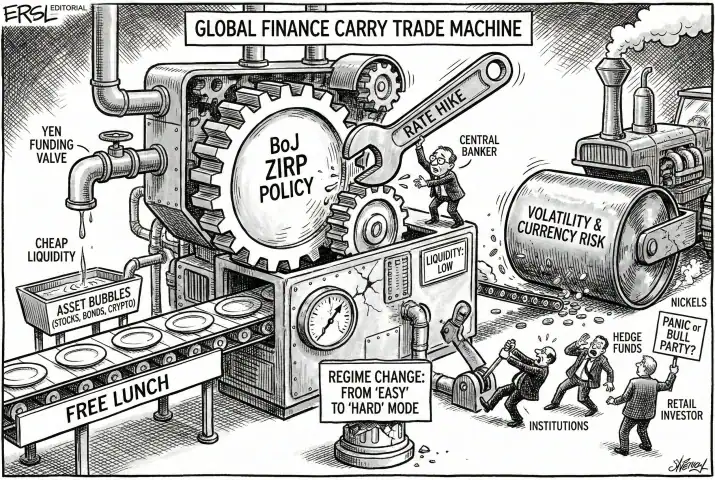
1. Executive Summary: Deconstructing the “Free Lunch” Narrative
The financial history of the early 21st century has been implicitly underwritten by a single, colossal anomaly: the zero-interest-rate policy (ZIRP) and negative-interest-rate policy (NIRP) of the Bank of Japan (BoJ). For nearly two decades, the global financial system has treated the Japanese Yen (JPY) not merely as a sovereign currency, but as a funding vehicle—a limitless credit facility with effectively zero cost, used to finance everything from U.S. Treasuries and high-growth technology stocks to emerging market bonds and cryptocurrencies.
The recent Reddit discussion titled “The Japanese Carry Trade is DEAD. Here’s What Happens Next!” captures a pivotal moment in market psychology. The original poster (OP) correctly identifies a seismic shift: with the Japanese 2-year government bond yield spiking and borrowing costs normalizing, the era of “free money” is confronting a structural wall. The user observes that the borrowing rates for the Yen are becoming competitive, dismantling the arbitrage that allowed investors to borrow at 0% and buy yielding assets elsewhere.
However, the binary polarization observed in the online discourse—described by the OP as vacillating between “full on panic at a slight breeze of change” and the “bull party forever group”—fails to capture the nuance of this transition. The unwind of the Yen carry trade is not a singular, cataclysmic event but a complex, multi-stage regime change. It is a process where the cost of capital reasserts itself in the world’s last anchor of low rates, fundamentally altering the liquidity dynamics that support global asset prices.
This report provides an exhaustive, expert-level analysis of this transition. It validates the OP’s intuition that the “easy money” era is concluding while refuting the notion that this inevitably leads to immediate systemic collapse. Instead, the analysis suggests a shift toward a regime of heightened volatility, higher structural correlation between asset classes, and a premium on liquidity over leverage. By dissecting the mechanics of the carry trade, the behavior of Japanese institutional investors, and the sensitivity of frontier assets like Bitcoin, this report outlines a refined investment philosophy for the post-ZIRP world.
2. The Anatomy of the Machine: A Technical Dissection of the Carry Trade
To understand the magnitude of the current shift, one must first dissect the machinery that is being dismantled. The “Carry Trade” is often discussed in abstract terms in casual forums, but it is a precise mathematical arbitrage deeply embedded in the plumbing of the global financial system. It relies on a specific set of variables: the funding cost (Japanese rates), the asset yield (foreign rates), and, crucially, the stability of the currency pair.
2.1 The Theoretical Framework: Uncovered Interest Parity (UIP) Failure
Economic theory, specifically Uncovered Interest Parity (UIP), suggests that the carry trade should not yield excess returns over the long run. The theory posits that the currency with the higher interest rate should depreciate against the currency with the lower interest rate by an amount exactly equal to the interest differential, thereby equalizing returns.
E = i(t) – i*(t)
Where:
- E is the expected change in the exchange rate.
- i(t) is the domestic interest rate (High Yield).
- i*(t) is the foreign interest rate (Low Yield / Funding Currency).
However, empirical evidence from the last thirty years demonstrates a persistent failure of UIP, known as the “forward premium puzzle”. In reality, high-interest-rate currencies often appreciate rather than depreciate, amplifying the returns of the carry trade. This anomaly created a feedback loop: as investors sold Yen to buy Dollars, they drove the Yen down and the Dollar up, making the trade even more profitable than the interest differential alone would suggest. This is the “free lunch” the Reddit OP refers to.
2.2 The Mechanics of the Trade
The trade operates through two primary channels:
- Direct Borrowing: Hedge funds and speculators borrow Yen directly from Japanese banks or through the repo market at near-zero rates. They convert these Yen into Dollars (selling JPY, buying USD) and invest in higher-yielding assets like U.S. Treasuries or equities. The profit is the spread minus the cost of currency hedging (if hedged) or the currency movement (if unhedged).
- Derivatives and FX Swaps: This is the “quantum mechanics” level of complexity alluded to in the Reddit post. Institutional investors use FX swaps to synthetically create Yen funding. The Bank for International Settlements (BIS) estimates that trillions of dollars in off-balance-sheet debt exist in the form of FX swaps, where the Yen serves as the funding leg.
2.3 The “Steamroller” Risk Profile
The carry trade is characterized by a return distribution known as negative skewness. Traders collect small, steady profits (the “carry”) for long periods, which are occasionally punctuated by massive, rapid losses. This dynamic is famously described as “picking up nickels in front of a steamroller”.
The “steamroller” is the rapid appreciation of the funding currency (the Yen). Because the trade is often highly leveraged (sometimes 10:1 or 20:1), a relatively small appreciation in the Yen can wipe out years of accumulated interest income in days. When the Yen appreciates, traders face margin calls. To meet these calls, they must sell their assets (Stocks, Bonds, Crypto) and buy back Yen. This buying pressure on the Yen causes it to appreciate further, triggering more margin calls for other traders. This self-reinforcing spiral is the mechanism of a “carry trade unwind.”
3. The Catalyst: The Bank of Japan’s Historic Pivot
The Reddit post specifically notes the “Japanese 2-year spiking overnight” as the harbinger of change. This observation is astute. The short end of the yield curve is the most sensitive barometer for monetary policy expectations, and its movement signals that the foundation of the carry trade—cheap, stable funding—is fracturing.
3.1 The End of Yield Curve Control (YCC)
For years, the BoJ practiced Yield Curve Control (YCC), pledging to buy unlimited amounts of 10-year Japanese Government Bonds (JGBs) to keep yields capped. This effectively made the BoJ the “volatility suppressor of last resort.” By capping yields, they dampened volatility, encouraging risk-taking globally.
Heading into late 2025, the BoJ has dismantled this framework. Governor Kazuo Ueda has overseen rate hikes that pushed the policy rate from -0.1% to 0.5% and potentially higher, with the 2-year JGB yield rising to over 1.02% by December 2025. While 1% may seem low compared to U.S. rates, the rate of change is violent. A move from 0.1% to 1.0% represents a ten-fold increase in funding costs for domestic players.
3.2 The Data: A Regime Change in Yields
The data illustrates a profound compression of the spreads that fueled the carry trade.
Table 1: The Closing Window – Yield Spreads (December 2025 Data)
| Metric | Japan (JPY) | United States (USD) | Spread (Carry) | Trend |
|---|---|---|---|---|
| Policy Rate | 0.50% | 4.25% – 4.50% | ~3.75% | Narrowing |
| 2-Year Bond Yield | 1.02% | 4.09% | 3.07% | Rapid Compression |
| 10-Year Bond Yield | 1.88% | 4.20% | 2.32% | Compression |
| Inflation (CPI) | ~2.5% | ~2.8% | 0.3% | Converging |
As the table demonstrates, the “cushion” for the carry trade is shrinking. More importantly, the volatility of the Japanese yield curve has increased. Traders can no longer rely on the BoJ to smooth out every ripple. The Reddit poster’s warning that “farewell easy money” is statistically supported by the erosion of the risk-free spread.
3.3 The Policy Dilemma: Inflation vs. Stability
The driving force behind this pivot is domestic inflation in Japan, which has persistently stayed above the 2% target. The BoJ faces a critical choice:
- Defend the Bond Market: Keep rates low to support the massive public debt, but risk destroying the Yen (currency collapse).
- Defend the Currency: Raise rates to support the Yen, but risk crashing the bond market and increasing debt service costs.
The BoJ has chosen a middle path—slow normalization—but the market is forcing their hand. The “spiking” 2-year yield indicates that the market believes the BoJ is behind the curve and will have to tighten more aggressively, further endangering carry trade positions.
4. The Repatriation Reality: The “Silent Whale” of Global Flows
While online discussions often focus on speculative hedge funds, the Reddit post rightly notes that “institutions are already doing all kind of crazy fking shit.” The true “whale” in this story is not the speculator, but the conservative Japanese institutional investor—specifically, Life Insurers and Pension Funds.
4.1 The Incentives of the Institutional Investor
Japanese life insurers hold trillions of dollars in assets. For decades, they were forced to invest overseas (buying U.S. Treasuries, French OATs, Australian Bonds) because domestic JGBs yielded zero. They took on currency risk to get yield.
Now, the calculus has inverted.
- The Foreign Option: Buy a 10-year U.S. Treasury yielding 4.2%. However, to be prudent, they must hedge the currency risk (sell USD, buy JPY forward). The cost of this hedge is determined by short-term interest rate differentials. With U.S. short rates high and Japanese short rates rising, the hedging cost is roughly 4-5%.
- Net Result: 4.2% Yield – 4.5% Hedge Cost = -0.3% Return.
- The Domestic Option: Buy a 30-year JGB yielding 2.2% or a 20-year corporate bond.
- Net Result: 2.2% Return (Risk-Free, No Currency Risk).
The math is undeniable. For a Japanese insurer, U.S. Treasuries are now “negative carry” assets on a hedged basis.
4.2 The “Great Repatriation”
This dynamic triggers what analysts call the “Great Repatriation.” It is not necessarily a panic sale, but a structural reallocation. As existing foreign bonds mature, the capital is not reinvested abroad; it is brought home to Tokyo to buy JGBs.
This has profound implications:
- Loss of Structural Demand for U.S. Debt: Japan is the largest foreign holder of U.S. Treasuries (over $1 trillion). If they stop buying, who fills the void? The U.S. Treasury must issue debt to price-sensitive buyers (domestic hedge funds, households), which exerts upward pressure on U.S. yields.
- Support for the Yen: The repatriation flow involves selling foreign currency (USD, EUR) and buying Yen. This creates a persistent bid for the Yen, acting as a headwind for the USD/JPY exchange rate.
4.3 The “Widowmaker” Reimagined
For twenty years, shorting JGBs was called the “Widowmaker” trade because the BoJ would always intervene to crush short sellers. Now, Japanese domestic investors are becoming the natural buyers of JGBs at these higher yields. This stabilizes the Japanese bond market but drains liquidity from the rest of the world. The Reddit OP’s intuition that money “will be parked elsewhere” is correct—that “elsewhere” is increasingly domestic Japan.
5. Market Impact Analysis: U.S. Treasuries and the “Sell America” Thesis
The Reddit comments express fear about a “global financial meltdown.” A specific vector of this fear is the idea that Japan will dump its U.S. Treasury holdings, causing a collapse in the U.S. bond market.
5.1 Dispelling the “Dump” Myth
The fear of a sudden “dump” of $1 trillion in bonds is largely exaggerated. As noted in recent analysis, Japanese institutions like pension funds rely on these assets for portfolio balance. A fire sale would crush the value of their own holdings and appreciate the Yen so violently that it would destroy Japan’s export economy. This is a “mutually assured destruction” scenario.
However, the marginal impact is real. We have seen specific institutions, such as Norinchukin Bank, selling heavily (approx. $63 billion) to cover losses from bad interest rate bets. While not a systemic dump, this selling contributes to the volatility of the U.S. yield curve.
5.2 Who Buys When Japan Sells?
If Japan steps back, the U.S. bond market becomes more reliant on “price-sensitive” domestic buyers.
- Households and Hedge Funds: These groups have increased their share of Treasury holdings. However, they demand a higher yield to take on the risk, unlike central banks that buy for policy reasons.
- Implication: This enforces a “higher for longer” reality for U.S. rates. The “term premium”—the extra yield investors demand for holding long-term debt—must rise to attract capital that was previously supplied by the BoJ’s carry trade recycling.
Analytical Insight: The “Sell America” narrative is false in terms of a boycott, but true in terms of price discovery. The U.S. can no longer rely on blind flows from Tokyo to subsidize its deficit.
6. The Crypto Connection: Bitcoin as the Canary in the Coal Mine
The Reddit post highlights a perceived contradiction: “The same group that’s predicting global financial meltdown is also telling us to invest in Bitcoin and Etherium.” This observation invites a deep dive into the correlation between the Yen carry trade and crypto assets.
6.1 Bitcoin as a Liquidity Derivative
Contrary to the “digital gold” narrative that paints Bitcoin solely as a safe haven, empirical data suggests Bitcoin acts primarily as a high-beta proxy for global liquidity. When the liquidity tap is open (cheap Yen, expanding M2), Bitcoin outperforms. When the tap tightens (Yen unwind, shrinking balance sheets), Bitcoin suffers.
Arthur Hayes, a prominent voice in this space, argues that the Yen carry trade unwind is the “death” of the liquidity regime that fueled crypto’s rise. In the initial phase of an unwind, Bitcoin is often one of the first assets sold. Why? Because it is liquid, trades 24/7, and has no circuit breakers. When a hedge fund faces a margin call on Monday morning in Tokyo, they sell their Bitcoin on Sunday night to raise cash.
6.2 The “Hayes Thesis”: Pain Then Gain
The argument for investing in Bitcoin despite the meltdown prediction relies on the reaction function of central banks. The thesis unfolds in stages:
- The Unwind (Pain): Yen strengthens, leverage is flushed, and asset prices (Stocks, Crypto) crash. This aligns with the “panic” described by the Reddit OP.
- The Break: The crash threatens a systemic institution (e.g., US Treasury market liquidity or a major bank).
- The Bailout (Gain): Central banks (Fed, BoJ) are forced to reverse course and inject massive liquidity to save the system. They print money to cap yields or provide swap lines.
- The Rally: Bitcoin, as an asset with a fixed supply (21 million), reprices higher in denomination of the newly debased fiat currency.
Investment Philosophy Lesson: In this framework, the “meltdown” is the prerequisite for the next bull run. The contradiction the OP sees is actually a sequential forecast: “The system will break (Bearish), forcing a bailout (Bullish).”
6.3 Volatility Sensitivity
Data from August 2024 supports this. When the Yen spiked, Bitcoin dropped roughly 20% in days. However, it recovered quickly as the BoJ walked back its hawkishness. This sensitivity makes Bitcoin an excellent “alarm system” for carry trade stress. If Bitcoin is crashing while traditional markets are quiet, it often signals that liquidity is being withdrawn in the plumbing of the financial system before it hits the headlines.
7. Historical Echoes: Lessons from 1998 and 2008
The Reddit OP laments that the sub “prior to Trump was actually decent with good DD” and lacks historical perspective. To provide that perspective, we must look at the ghosts of carry trades past. The current dynamics echo two specific crises.
7.1 The 1998 LTCM Crisis
In 1998, Long-Term Capital Management (LTCM), a hedge fund run by Nobel laureates, leveraged the Yen carry trade to the hilt. They bet that spreads would converge. When Russia defaulted and the Yen surged (appreciating over 7% in a single day in October 1998), their models blew up.
Key Lesson: Correlations go to 1.0 in a crisis. LTCM thought their positions were diversified. But when the funding currency (Yen) ripped higher, they had to sell everything—liquid and illiquid alike—to cover the Yen loans. The “free lunch” turned into a liquidation spiral.
7.2 The 2008 Global Financial Crisis
While the GFC was triggered by subprime mortgages, the Yen carry trade acted as an accelerant. From 2005 to 2007, the carry trade was massive. When risk aversion spiked in 2008, the unwind began. The Yen appreciated nearly 20% against major currencies, crushing anyone short JPY.
Key Lesson: The unwind happens when you can least afford it. The carry trade usually unwinds exactly when the global economy is slowing (risk-off), exacerbating the downturn. It removes liquidity precisely when the system needs it most.
7.3 The August 2024 “Black Monday”
More recently, the events of August 5, 2024, served as a “dress rehearsal.” A small rate hike by the BoJ caused the Nikkei to fall 12% in a day, its worst drop since 1987. This proved that even after decades, the market is structurally addicted to cheap Yen. The “muscle memory” of the market is to sell everything when the Yen rises.
The user requested an expert’s investment philosophy and lessons. The analysis of the Reddit post and the underlying data suggests a specific philosophical approach to the current environment.
8.1 Philosophy: The “Anti-Fragile” Approach to Volatility
The Reddit OP criticizes the “bull party forever” group. In a carry trade unwind, a “buy and hold” strategy can be disastrous because the drawdown is systemic. The philosophy for this regime is Anti-Fragility. You want to own assets that benefit from volatility or are agnostic to it.
Lesson from Failure: Many investors fail by “reaching for yield” (picking up nickels) without respecting the “steamroller.” They sell volatility (via short options or carry trades) to generate income. This works for years until it wipes you out in a day.
Lesson from Success: The most successful trades during a regime change are Convex Trades. Buying long-dated options on the Yen (betting it goes up) or long volatility (VIX calls) costs a small premium (the nickel) but pays out massively if the steamroller arrives (the jackpot).
8.2 Refining Investment Ideas
Based on the research, here are refined analytical logics for specific positions:
- Avoid “ZIRP Zombies”:
Companies and assets that only survived because they could borrow at near-zero rates are “ZIRP Zombies.” As the Yen carry trade dies, the global cost of capital rises.
- Action: Screen for companies with high debt loads and low cash flow. They will not survive the refinancing wall. The “free lunch” of cheap debt is over.
2. Respect the Repatriation Flow:
- Idea: If Japanese insurers are buying JGBs and selling foreign bonds, the yield curve in Japan will stabilize, but the yield curve in the US/Europe will steepen.
- Action: Be cautious of long-duration U.S. bonds (20y+) unless you believe a U.S. recession is imminent. The structural buyer (Japan) is leaving the building.
3. Bitcoin as a “Phase 2” Trade:
- Logic: Don’t buy Bitcoin because you think the carry trade is “fine.” Buy it because you think the carry trade unwind will force the Fed to print.
- Action: Expect volatility. If USD/JPY crashes to 140 or 130, expect Bitcoin to sell off initially (liquidity shock). That dip is the entry point for the “bailout” thesis.
4. The Yen as a Hedge:
- Logic: In a global recession, the Fed cuts rates while the BoJ holds or hikes. The spread compresses, and the Yen rips higher.
- Action: Holding cash in Yen or Yen-denominated assets can act as a hedge against a U.S. equity correction. It is one of the few assets that is negatively correlated to the S&P 500 during a crash.
9. Conclusion: The Market Has Moved from “Easy” to “Hard” Mode
The Reddit post argues that “The world of finance is fking massive and complex.” This is true. The complexity lies in the hidden linkages—the FX swaps, the offshore leverage, the algorithmic correlations—that bind the Japanese 2-year yield to the price of Nvidia and Bitcoin.
The “Death of the Carry Trade” does not mean the end of markets. It means the end of Low Volatility. The “Free Lunch” provided by the BoJ—the suppression of volatility and the provision of infinite liquidity—is being withdrawn.
Key Takeaways for the Community:
- Don’t Panic, But Adjust: The unwind is a process, not a singular event. It will play out over 12-24 months as bonds mature and policies normalize.
- Watch the 2-Year Yield: This is your compass. If Japanese short-term rates continue to rise, the pressure on risk assets will intensify.
- Ignore the Politics: As the OP notes, political bias blinds you to fundamentals. The flows of the Japanese pension funds do not care about U.S. elections; they care about yield spreads and hedging costs. Follow the math, not the narrative.
The era of the “infinite carry” is over. The new era will be defined by the real cost of capital. For the disciplined investor, this return to reality is not a disaster—it is the ultimate opportunity to separate signal from noise.
10. References & Further Reading
The following sources provide the data and expert commentary used to construct this report. They are recommended for readers seeking to verify technical claims or explore the specific mechanics of the carry trade.
Bank for International Settlements (BIS) Bulletin No. 90
Link: [https://www.bis.org/publ/bisbull90.pdf]
Note: This is the definitive technical source on how the carry trade operates in the shadows via FX swaps. It explains the “hidden debt” that does not appear on standard balance sheets. Use this to understand the systemic risk that isn’t visible in headline news.
Arthur Hayes / BitMEX Research: “Spirited Away”
Link: [https://cryptohayes.medium.com/spirited-away-4f37cf930273]
Note: Arthur Hayes offers a specific thesis linking the Yen’s value to Bitcoin prices. He argues that a strong Yen drains liquidity, hurting crypto, but eventually forces central banks to print money, boosting crypto. This source explains the “Pain then Gain” thesis mentioned in Section 6.
YouTube: Arthur Hayes Interview on Global Liquidity
Note: A video interview where Hayes breaks down the “bull market math” and the correlation between global liquidity (driven by the Yen and USD) and crypto assets. Useful for a more accessible, audio-visual explanation of the complex liquidity flows.
U.S. Treasury Data: Foreign Holdings of U.S. Securities
Link: [https://home.treasury.gov/news/press-releases/sb0253]
Note: Official data tracking foreign ownership of U.S. securities. This is the primary source for verifying whether Japan is “dumping” or merely “reallocating” their treasury holdings.
Investing.com Analysis: Carry Trade Risks in 2025
Note: A market-focused analysis of the specific risks facing the carry trade in late 2025, specifically regarding the “spiking” 2-year yields mentioned in the report.
Leave a Reply